
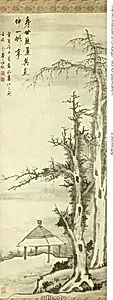
A Thatched Pavilion at the Foot of Two Old Cedar Trees
Qing dynasty (1644–1911), dated 1693
Medium
Hanging scroll; ink on paper
Dimensions
195.6 × 73.7 cm (77 × 29 in.)
Classification
hanging scroll
Department
Arts of Asia
Museum
Art Institute of Chicago
Accession Number
13451
Rights
Public Domain
Art Historical Context
Created during the early years of the Qing dynasty, Luo Mu’s “A Thatched Pavilion at the Foot of Two Old Cedar Trees” captures the enduring appeal of Chinese landscape painting. Dated 1693, the large hanging scroll invites viewers to pause beneath towering cedars and imagine a quiet retreat in nature. Such scenes were especially resonant in the late seventeenth century, when scholar-artists often turned to painting as a means of personal reflection amid political change. Executed in ink on paper, the work highlights the expressive possibilities of the brush. Luo Mu employs varying tones and textures to suggest the rugged bark of ancient trees and the modest shelter nestled below, demonstrating the traditional Chinese belief that a few well-placed strokes can convey both form and spirit. The vertical format of the hanging scroll guides the eye upward, echoing the natural growth of the cedars and reinforcing themes of longevity and harmony with the natural world. Today housed in the Art Institute of Chicago’s Arts of Asia collection, the painting continues to offer visitors a moment of calm contemplation, much as it did for its original audience more than three centuries ago.