
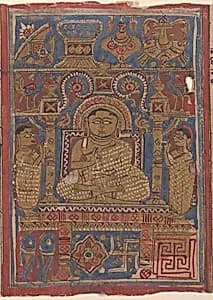
A Tirthankara and the Eight Auspicious Symbols; Page from a Dispersed Kalpa Sutra (Jain Book of Rituals)
Unknown Artist
15th century
Medium
Ink, opaque watercolor, and gold on paper
Dimensions
4 3/8 x 10 5/8 in. (11.1 x 27 cm)
Classification
Paintings
Culture
India (Gujarat)
Department
Asian Art
Museum
Metropolitan Museum of Art, New York, NY
Credit
Rogers Fund, 1955
Accession Number
55.121.38.1
Rights
Public Domain
Tags
Art Historical Context
This exquisite 15th-century page from a dispersed *Kalpa Sutra*, a foundational Jain text outlining rituals, monastic rules, and the lives of revered Tirthankaras, hails from Gujarat, India. At its center stands a Tirthank—one of Jainism's 24 spiritual liberators—flanked by the Eight Auspicious Symbols (*Ashtamangala*), including the swastika, lotus, and conch, which embody prosperity, purity, and cosmic harmony. These manuscripts were vital for Jain communities, serving as both devotional aids and educational tools during a golden age of Western Indian painting. Crafted with ink, opaque watercolor, and gold on paper, the artwork exemplifies the refined techniques of Gujarati Jain ateliers. Vibrant hues and intricate gold detailing create a luminous, jewel-like quality, typical of palm-leaf manuscript traditions adapted to paper. The horizontal format (4 3/8 x 10 5/8 in.) allowed for narrative sequences, blending devotional iconography with symbolic depth. Though the artist remains unknown, such pages reflect the patronage of wealthy Jain merchants, preserving sacred stories amid medieval India's religious pluralism. Today, housed in the Metropolitan Museum of Art's Asian Art Department (Rogers Fund, 1955), this fragment invites visitors to ponder Jainism's emphasis on non-violence and enlightenment, where even symbols whisper profound truths. Note the subtle inclusion of female figures, highlighting women's roles in Jain devotion.