
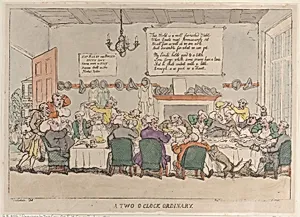
A Two O'Clock Ordinary
June 4, 1811
Medium
Hand-colored etching; reprint
Dimensions
Sheet: 10 1/16 × 14 1/8 in. (25.6 × 35.9 cm)
Classification
Prints
Department
Drawings and Prints
Museum
Metropolitan Museum of Art, New York, NY
Credit
The Elisha Whittelsey Collection, The Elisha Whittelsey Fund, 1959
Accession Number
59.533.1761
Rights
Public Domain
Tags
Art Historical Context
Thomas Rowlandson's *A Two O'Clock* (1811) the boisterous spirit of Regency England through a hand-colored etching, a popular medium for satirical prints that allowed vibrant hues to enhance the humor. Measuring about 10 by 14 inches, reprint from the Metropolitan Museum of Art's Elisha Whittelsey Collection exemplifies Rowlandson's mastery of caricature, blending sharp social observation with exaggerated, lively figures. The scene satirizes a "two o'clock ordinary"—a fixed-price public dining house frequented by men of various classes. Amidst the chaos of feasting, dogs scamper under tables, symbolizing the rowdy, indulgent atmosphere of early 19th-century taverns. Rowlandson, a leading figure in British satire alongside artists like Gillray, pokes fun at gluttony, camaraderie, and everyday vices, reflecting the era's growing urban leisure culture. This print's enduring appeal lies in its witty commentary on human folly, making it a window into Georgian social life. Visitors will delight in Rowlandson's fluid lines and playful colors, which bring the lively diner to vivid life.
About the Artist
Thomas Rowlandson · 1756–1827
Thomas Rowlandson (1757–1827) was an English artist and caricaturist whose satirical watercolors and prints captured the social life of Georgian Britain with unparalleled wit and technical mastery. Alongside James Gillray, he is recognized as one of the greatest British graphic artists, and his distinctive flowing line and keen observations have made his work integral to understanding late 18th an...