
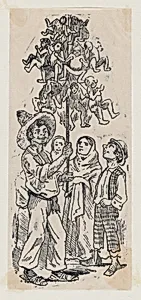
A vendor selling toys
ca. 1880–1910
Medium
Zincograph
Dimensions
Sheet: 5 1/2 × 2 1/2 in. (14 × 6.3 cm)
Classification
Prints
Department
Drawings and Prints
Museum
Metropolitan Museum of Art, New York, NY
Credit
Gift of Jean Charlot, 1930
Accession Number
30.82.64
Rights
Public Domain
Tags
Art Historical Context
José Guadalupe Posada, a pioneering Mexican printmaker active in Mexico City from the late 19th to early 20th century, *A Vendor Selling Toys* around 1880–1910. This zincograph captures a lively street scene of everyday life, featuring a vendor hawking toys amid men and women, reflecting the bustling markets of urban Mexico. Posada's-inspired style, with bold lines and satirical undertones, elevated humble subjects into powerful social commentary, making art accessible to the working class. Zincography, Posada's preferred technique, involved etching designs onto zinc plates for lithography—a cost-effective method that enabled mass production of broadsheets and newspapers. At just 5½ × 2½ inches, this compact print was ideal for affordable distribution, appearing in publications like *El Jocoqui*. It exemplifies Posada's mastery of relief printing, which allowed crisp details and vibrant contrasts despite the modest medium. Posada's work, including this charming depiction of commerce and play, foreshadowed the Mexican printmaking revival and influenced modernists like Diego Rivera. Donated to the Metropolitan Museum of Art in 1930 by Jean Charlot, it preserves a snapshot of pre-Revolutionary Mexico, where toys symbolized joy amid hardship, inviting visitors to appreciate the artistry in ordinary moments.
About the Artist
José Guadalupe Posada · 1852–1913
José Guadalupe Posada (1852-1913) was a Mexican printmaker and engraver who revolutionized popular art and created some of the most iconic images in Mexican culture. Working primarily with publisher Antonio Vanegas Arroyo, he produced over 20,000 images during his career—inexpensive broadsheets sold for a penny on colored paper that made his art accessible to even the poorest workers. He transform...