
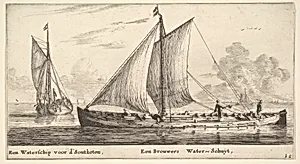
A "Watership" Carrying Water for Salt Works and Another One Carrying Water for the Breweries
17th century
Medium
Etching; second state
Dimensions
sheet: 5 1/4 x 9 3/4 in. (13.3 x 24.7 cm)
Classification
Prints
Department
Drawings and Prints
Museum
Metropolitan Museum of Art, New York, NY
Credit
Rogers Fund, 1920
Accession Number
20.24.18
Rights
Public Domain
Tags
Art Historical Context
Reinier Nooms, known Zeeman (“Seaman”), was a Dutch marine artist of the 17th century whose etchings captured the everyday activity of the Netherlands’ bustling waterways during the Dutch Golden Age. This print depicts two specialized “waterships”—vessels designed to transport fresh water—serving the salt works and the breweries, respectively. The detailed rendering of hulls, rigging, and cargo highlights the vital role these modest craft played in supporting vital industries that sustained Dutch cities and export trade. Etchings such as this one allowed Nooms to reach a wide audience with affordable images of maritime life. Working in the second state of the plate, he refined the lines to emphasize the calm coordination of the ships under sail, reflecting technical precision and an appreciation for the quiet labor that underpinned the Republic’s prosperity. Today the sheet is preserved in the Metropolitan Museum of Art’s collection of prints and drawings. The modest scale—roughly five by ten inches—invites close looking, rewarding viewers with a glimpse of how water, salt, and beer were once moved by sail along the same canals that helped shape the Dutch economy and identity.
About the Artist
Reinier Nooms, called Zeeman · 1623–1664
Reinier Nooms, known as Zeeman ("sailor" in Dutch), was a prominent Dutch maritime painter, draftsman, and etcher of the Golden Age, born around 1623 or 1624 in Amsterdam and dying there in 1664 at about age 40. Before turning to art around 1643, he led a rough life as a professional seaman, which informed his unparalleled accuracy in depicting ships, ports, naval battles, and coastal scenes—knowl...