
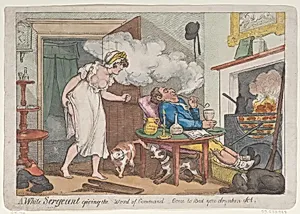
A White Sergeant giving the word of command - "Come to Bed you drunken sot"
May 25, 1807
Medium
Hand-colored etching; reverse copy
Dimensions
Sheet: 8 11/16 × 12 5/8 in. (22 × 32 cm)
Classification
Prints
Department
Drawings and Prints
Museum
Metropolitan Museum of Art, New York, NY
Credit
The Elisha Whittelsey Collection, The Elisha Whittelsey Fund, 1959
Accession Number
59.533.988
Rights
Public Domain
Tags
Art Historical Context
In the lively world of early 19th-century British satire, Thomas Rowlandson a master caricaturist of the Regency era, created *A White Sergeant giving the word of command -Come to Bed you drunken"* on May 25, 1807. This hand-colored etching, a reverse copy possibly involving William McCleary, 8 11/16 × 12 5/8 inches and captures Rowlandson's signature style of exaggerated humor targeting social vices. Housed in the Metropolitan Museum of Art's Drawings and Prints department, it reflects the era's booming market for affordable, colorful prints that poked fun at everyday life. The scene humorously depicts a no-nonsense woman—perhaps a "white sergeant" in domestic command—scolding her drunken husband with the sharp order to bed, amid tags of men, women, smoking, cats, and dogs. Rowlandson's work often lampooned alcohol-fueled chaos in middle-class homes, mirroring Regency England's tensions between military pomp, gender roles, and intemperance. The etching's vibrant hand-coloring enhances its comic punch, making it a lively commentary on marital strife and leisure habits like pipe-smoking. As a reverse copy, this print highlights the era's piracy culture in caricature production, where popular images were quickly reproduced for wider audiences. Rowlandson's loose, fluid lines and satirical bite made him a rival to contemporaries like Gillray, offering museum visitors a window into the witty, unflinching social critique of 1807 Britain.
About the Artist
Thomas Rowlandson|William McCleary · 1756–1827
Thomas Rowlandson (1757–1827) was an English artist and caricaturist whose satirical watercolors and prints captured the social life of Georgian Britain with unparalleled wit and technical mastery. Alongside James Gillray, he is recognized as one of the greatest British graphic artists, and his distinctive flowing line and keen observations have made his work integral to understanding late 18th an...