
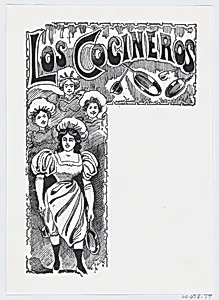
A woman holding a pan and ladle with other women and cooking supplies in the background
ca. 1880–1910
Medium
Zincograph
Dimensions
Sheet: 7 1/16 × 5 1/8 in. (18 × 13 cm) Image: 6 3/16 × 4 1/8 in. (15.7 × 10.5 cm)
Classification
Prints
Department
Drawings and Prints
Museum
Metropolitan Museum of Art, New York, NY
Credit
Gift of Roberto Berdecio, 1960
Accession Number
60.678.77
Rights
Public Domain
Tags
Art Historical Context
This lively zincograph by José Guadalupe Posada, master of Mexican popular printmaking, captures a bustling kitchen scene titled *A Woman Holding a Pan and Ladle with Other Women and Cooking Supplies in the Background*. Created 1880–1910, it measures a compact 7 1/16 × 5 1/8 inches and exemplifies Posada's collaboration with printers like José Sanchez. Zincography, a relief printing technique using zinc plates, allowed for affordable, high-volume production of broadsheets that brought art to the masses in Mexico during a time of social upheaval leading to the Revolution. Posada's bold, folk-inspired style—characterized by stark black lines and exaggerated forms—elevates everyday domestic life into vivid social commentary. Here, women dominate the frame, wielding utensils amid pots and pans, reflecting the central role of female labor in Mexican households. These prints often appeared in newspapers and chapbooks, blending humor, satire, and realism to engage working-class audiences. Housed in the Metropolitan Museum of Art's Drawings and Prints department (gift of Roberto Berdecio, 1960), this work highlights Posada's enduring influence on Mexican graphic art, from Diego Rivera to modern street art, preserving glimpses of 19th-century cultural vibrancy.
About the Artist
José Guadalupe Posada|José Sanchez · 1852–1913
José Guadalupe Posada (1852-1913) was a Mexican printmaker and engraver who revolutionized popular art and created some of the most iconic images in Mexican culture. Working primarily with publisher Antonio Vanegas Arroyo, he produced over 20,000 images during his career—inexpensive broadsheets sold for a penny on colored paper that made his art accessible to even the poorest workers. He transform...