
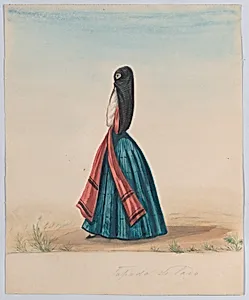
A woman wearing the saya and manto standing in profile, from a group of drawings depicting Peruvian dress
ca. 1848
Medium
Watercolor
Dimensions
Sheet: 9 1/16 × 7 1/2 in. (23 × 19 cm)
Classification
Drawings
Department
Drawings and Prints
Museum
Metropolitan Museum of Art, New York, NY
Credit
Bequest of Mary Martin, 1938
Accession Number
38.145.464
Rights
Public Domain
Tags
Art Historical Context
In this delicate watercolor from around 1848, Peruvian artist Francisco (Pancho) Fierro captures a woman in profile, elegantly dressed in the traditional *saya*—a fitted skirt—and *manto*, a flowing shawl that drapes over the shoulders. Part of a larger series documenting Peruvian dress, the 9 1/16 × 7 1/2-inch sheet showcases Fierro's keen eye for everyday fashion in mid-19th-century Lima, a time when Peru was forging its post-independence identity. Fierro, a self-taught artist of African descent celebrated for his *costumbrista* style, vividly portrayed the diverse social types and customs of his homeland. These works preserve the *tapada limeña* aesthetic, where women veiled their faces with the *manto* for modesty and allure, reflecting criollo (Spanish-descended) culture amid a multicultural society. His watercolors, now in the Metropolitan Museum of Art's Drawings and Prints department, offer invaluable glimpses into Peru's vibrant street life. The intimate scale and luminous technique highlight Fierro's mastery of watercolor, blending fine lines with subtle color washes to evoke texture and poise. A bequest from Mary Martin in 1938 ensures this cultural treasure endures, inviting us to appreciate Peru's rich sartorial heritage.
About the Artist
Francisco (Pancho) Fierro · 1807–1879
Francisco Fierro, known affectionately as Pancho Fierro, was born in Lima, Peru, in 1807, the son of an African-descended enslaved woman and, by some accounts, a Spanish priest. He grew up in the social margins of colonial and early republican Lima, and his art is inseparable from that position: an acute, sympathetic, and often satirical observer of a society stratified by race, class, and custom....