
Aarde en vuur
Medium
engraving
Dimensions
211; 263
Rights
Public Domain
About this artwork
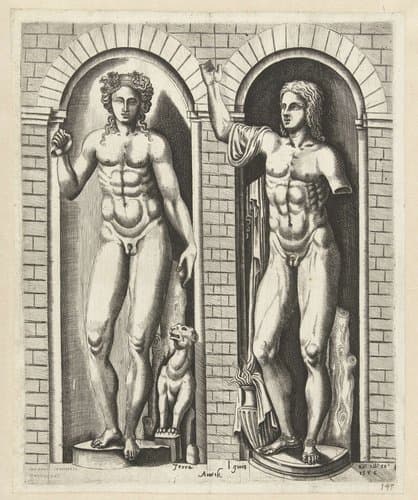
Twee arcades met beelden. Links de personificatie van aarde en rechts de personificatie van vuur. Aarde is een naakte man met bloemen in het haar. Een leeuw en een boomstronk bevinden zich naast zijn voeten. Vuur is een naakte jongeling. Zijn rechtervingers en linkerarm ontbreken. Naast hem staat een vuurpot.
Art Historical Context
Balthazar van den Bos’s 1558 engraving *Aarde en vuur* presents two elegant arcades framing the personifications of Earth and Fire, rendered with the precise linework characteristic of mid-sixteenth-century Flemish printmaking. On the left, Earth appears as a nude male figure crowned with flowers, accompanied by a lion and a weathered tree stump at his feet. To the right stands Fire, depicted as a youthful nude whose missing fingers and arm suggest either an antique fragment or a deliberate reference to classical ruins. Created during the Renaissance, when artists revived ancient allegories of the four elements, the print reflects the period’s fascination with both natural philosophy and classical sculpture. Engravings like this one allowed such imagery to circulate widely among collectors and scholars, translating monumental ideas into intimate, portable formats. The architectural setting further evokes Roman or Italianate design, underscoring the era’s admiration for antiquity. Van den Bos’s technique highlights the tactile qualities of stone and flesh, inviting viewers to appreciate the symbolic attributes—floral abundance for Earth and the flickering fire pot for its elemental counterpart—while celebrating the enduring dialogue between nature and human creativity.