
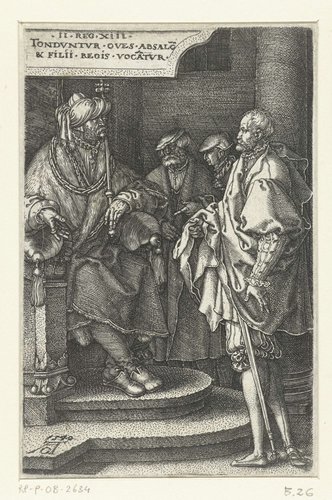
Absalom nodigt David en zijn broeders uit voor een feestmaal
Medium
engraving
Dimensions
77; 120
Rights
Public Domain
About this artwork
gravure
Art Historical Context
Heinrich Aldegrever's *Absalom nodigt David en zijn broeders uit voor een feestmaal* (Absalom Invites David and His Brothers to a Feast), created in 1540, is a delicate engraving measuring just 120 mm by 77 mm. As one of the renowned "Little Masters" of the German Renaissance, Aldegrever was a master engraver and goldsmith from Soest, whose intricate works drew inspiration from Albrecht Dürer and the Northern Renaissance tradition. This small-scale print captures a pivotal biblical moment from 2 Samuel 13, where Absalom schemes to avenge his sister Tamar by luring his brothers—including the ill-fated Amnon—to a feast, foreshadowing tragedy within King David's family. Engravings like this one were revolutionary in the 16th century, allowing detailed images to be reproduced affordably and widely distributed across Europe. Aldegrever's technique shines in the fine lines and textures that evoke the opulence of the feast: flowing garments, architectural details, and expressive figures crowded around tables laden with food. The composition's intimacy suits its diminutive size, making it ideal for collectors' cabinets or devotional use. This piece reflects the era's fascination with moralistic biblical narratives, blending artistic virtuosity with spiritual reflection. Aldegrever produced over 200 engravings, many on religious themes, underscoring his role in disseminating Renaissance humanism through printmaking. A gem for any visitor, it invites closer inspection to uncover its narrative depth.
About the Artist
Heinrich Aldegrever · 1502–1561
Heinrich Aldegrever, born in 1502 in Paderborn, Westphalia, to parents Herman and Katherine Trippenmeker—a family of clog-makers known by the dialect name Trippenmecker—emerged as a multifaceted artist in the German Renaissance. His early training remains undocumented, though he likely apprenticed in a Soest goldsmith's workshop after relocating there around 1525, where he joined the painters' gui...