
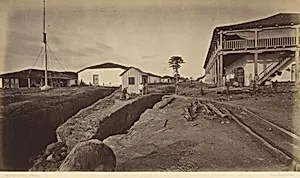
Acajutla
Medium
albumen print
Dimensions
image: 13.7 x 24 cm (5 3/8 x 9 7/16 in.) overall: 24.9 x 33.3 cm (9 13/16 x 13 1/8 in.)
Classification
Photograph
Department
CPH
Museum
National Gallery of Art, Washington, D.C.
Credit
Gift of Mitchell and Nancy Steir
Accession Number
2004.163.6
Rights
Public Domain
Art Historical Context
**Acajutla, 1877** Eadweard Muybridge, the pioneering British photographer renowned for his groundbreaking motion studies, captured *Acajutla* during his travels through Central America in the mid-1870s. This albumen print depicts the coastal port town of Acajutla in El Salvador, a hub of trade and maritime activity along the Pacific. Muybridge's expedition produced a series of vivid landscapes, blending his sharp eye for detail with the era's exploratory spirit, just before his fame exploded with sequential photographs of galloping horses. Printed on albumen paper—coated with egg whites for its luminous tones and fine grain—this panoramic image (13.7 x 24 cm) showcases Muybridge's mastery of large-format photography. The medium, dominant in the 19th century, allowed for exceptional clarity in expansive vistas, inviting viewers to immerse in distant horizons and bustling harbors. Housed in the National Gallery of Art's photography collection (gift of Mitchell and Nancy Steir), *Acajutla* highlights Muybridge's versatility beyond motion experiments, preserving a snapshot of 1870s Latin American life. It's a testament to photography's power as both art and document, bridging continents for modern audiences.
About the Artist
Eadweard Muybridge · 1830–1904
Eadweard Muybridge (1830-1904) was an English-American photographer who revolutionized the understanding of motion through his pioneering chronophotographic studies. Born Edward James Muggeridge in Kingston upon Thames, England, he emigrated to America and became famous first for his dramatic landscape photographs of Yosemite Valley, then for his groundbreaking motion studies that proved horses li...