
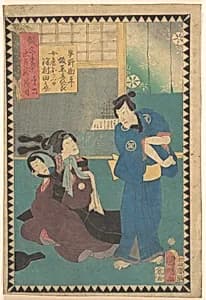
Act VI (Dai rokudanme): Actors Bandō Hikosaburō as Hayano Kanpei and Sawamura Tanosuke as His Wife Okaru, from the series The Storehouse of Loyal Retainers, a Primer (Kanadehon chūshingura)
1862 (Bunkyū 2), 6th month
Medium
Woodblock print; ink and color on paper
Dimensions
Image: 14 in. × 9 5/8 in. (35.6 × 24.4 cm)
Classification
Prints
Culture & Period
Japan · Edo period (1615–1868)
Department
Asian Art
Museum
Metropolitan Museum of Art, New York, NY
Credit
Museum Accession
Accession Number
JP1094c
Rights
Public Domain
Tags
Art Historical Context
This exquisite woodblock print by Utagawa Kuniaki II, created in 1862 during late Edo period, captures a dramatic moment from *Act VI* of *Kanadehon Chūshingura* (The Storehouse of Loyal Ret, a Primer), a kabuki play series. features renowned actors Bandō Hikosaburō as the loyal samurai Hayano Kanpei and Sawamura Tanosuke his devoted wife Okaru. Rendered in vibrant ink and color on paper14 × 9⅝ in.), the image exemplifies the ukiyo-e tradition of *yakusha-e* (actor prints), which immortalized kabuki stars for everyday fans. *Chūshingura*, loosely based on the true 18th-century tale of the 47 ronin—their epic quest for vengeance after their lord's forced suicide—embodies bushido ideals of loyalty, honor, and sacrifice. This scene likely highlights the emotional tension between Kanpei and Okaru, with motifs like mirrors symbolizing introspection or revelation amid their perilous plot. As part of the Utagawa school's dynamic style, Kuniaki II's precise lines, bold colors, and expressive poses bring the theater's intensity to life, making high art accessible through affordable prints. Housed in the Metropolitan Museum of Art's Asian Art department, this work reflects Edo Japan's thriving print culture, where woodblock techniques allowed mass production of cultural icons, bridging theater and visual art for all social classes. A window into fleeting performances and timeless samurai drama!
About the Artist
Utagawa Kuniaki II · 1835–1888
Japanese, 1835–1888