
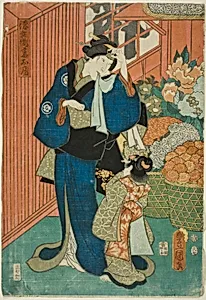
Actors Kataoka Gado II as Florist (Hanaya) Tokubei (R) and Nakamura Daikichi III as Tokubei's Wife (Tsuma) Ofusa (L)
Medium
Color woodblock print
Classification
Department
Arts of Asia
Museum
Art Institute of Chicago
Accession Number
37667
Rights
Public Domain
Art Historical Context
Step into the vibrant world of 19th-century Japanese theater this striking color woodblock print by Utagawa Kunada I (also known as Toyokuni), created in 1855. The artwork captures two kabuki stars in dynamic roles: Kataoka Gadō II as the floristubei on the right, and Nakamuraikichi III as his Ofusa on the left Kunisada, a master of the uki-e ("pictures of the floating world"), specialized in yakusha-e—prints portraying actors—which brought the drama of Edo-period stage performances to everyday viewers. Produced during the late Edo era, just before Japan's modernization, this nishiki-e (brocade print) showcases the intricate artistry of woodblock printing. Multiple carved blocks were inked in vivid hues and layered precisely to create rich textures, glowing colors, and expressive poses that convey the actors' emotions and exaggerated kabuki gestures. These affordable prints democratized theater culture, allowing fans to own a piece of the spectacle at home. Housed in the Art Institute of Chicago's Arts of Asia collection, this work highlights kabuki's cultural allure—blending romance, tragedy, and spectacle in tales of ordinary lives turned dramatic. Kunisada's bold style influenced global art, bridging East and West for generations of admirers.
About the Artist
Utagawa Kunisada I (Toyokuni III) · 1786–1864
Utagawa Kunisada I, also known as Toyokuni III (1786–1865), was born Sumida Shōgorō in the Honjo district of Edo (modern Tokyo) into a family that operated a hereditary ferry-boat service, providing stability after his father's early death. Displaying prodigious talent in drawing from childhood, he became an apprentice to the master Utagawa Toyokuni I around 1801 at age fifteen, entering the prest...