
3/8
Medium
engraving
Dimensions
49; 76
Rights
Public Domain
About this artwork
number: ‘102’
Art Historical Context
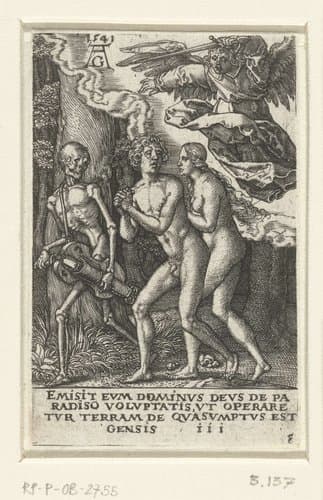
Heinrich Aldegre's *3/8*, created in 1541, is a delicate engraving measuring just 76 mm high by 49 mm wide—small enough to fit in the palm of your hand. As one of the renowned "Little Masters" of the Northern Renaissance, Aldegrever was German goldsmith and printmaker based in Soest, celebrated for his intricate small-scale works that rivaled the grandeur of larger paintings. This engraving exemplifies the technical virtuosity of 16th-century printmaking, where Aldegrever incised fine lines into a copper plate with a burin, capturing extraordinary detail in a miniature format. Likely part of a numbered series (hinted by its title and catalog number '102'), it reflects the era's fascination with ornamental designs and moral allegories, often used by artisans for patterns in jewelry and metalwork. Prints like this democratized art, allowing images to be widely reproduced and collected across Europe. Aldegrever's style, influenced by Albrecht Dürer, blends precise linework with a sense of depth and texture, making *3/8* a gem of Renaissance ingenuity. Imagine owning a piece of history that once inspired craftsmen—its cultural role underscores how engravings bridged fine art and everyday design in the Reformation age.
About the Artist
Heinrich Aldegrever · 1502–1561
Heinrich Aldegrever, born in 1502 in Paderborn, Westphalia, to parents Herman and Katherine Trippenmeker—a family of clog-makers known by the dialect name Trippenmecker—emerged as a multifaceted artist in the German Renaissance. His early training remains undocumented, though he likely apprenticed in a Soest goldsmith's workshop after relocating there around 1525, where he joined the painters' gui...