
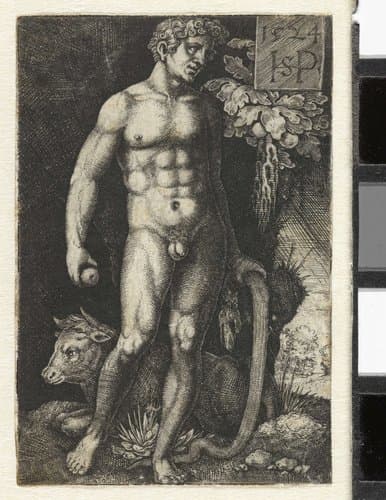
Adam met slang en appel en liggende stier
Medium
engraving
Dimensions
52; 79
Rights
Public Domain
About this artwork
collector's mark: Lugt 2228a
Art Historical Context
Hans Sebald Beham, a master engraver from Nuremberg and one of the "Little Masters" of the Northern Renaissance, created *Adam met slang en appel en liggende stier* in 1524. This intimate engraving, measuring just 79 x 52 mm, exemplifies the precision of early 16th-century German printmaking during a time of religious upheaval, including the Reformation's stirrings in Beham's Protestant-leaning hometown. Beham, known for his intricate biblical and mythological scenes, often infused his works with symbolic depth, blending humanism with Lutheran critique of Catholic imagery. The composition depicts Adam alongside the serpent and apple—icons of temptation from Genesis—paired with a reclining bull, evoking themes of paradise, sin, and earthly fertility. Engraving allowed Beham to achieve extraordinary fine lines and textures on a tiny scale, with cross-hatching for shading and minute details in foliage or animal forms that reward close viewing. This technique made prints affordable and widely distributable, spreading Renaissance ideas beyond elite patrons. Bearing the collector's mark Lugt 2228a, this piece traces to a distinguished provenance, highlighting its enduring appeal. For visitors, it offers a window into how small-scale art captured profound narratives, bridging faith, nature, and artistry in Reformation-era Europe.
About the Artist
Hans Sebald Beham · 1500–1550
Sebald Beham (1500-1550), often called Hans Sebald Beham, was a German painter and printmaker born in Nuremberg. He stands as the most important figure among the Kleinmeister (Little Masters), a group of German artists who created remarkably detailed prints on a diminutive scale in the generation following Albrecht Dürer. Beham's significance lies in his technical virtuosity and unprecedented pro...