
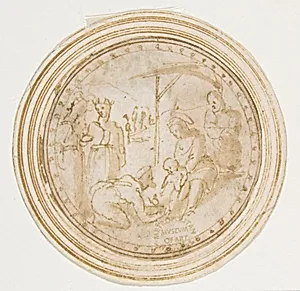
Adoration of the Magi
16th century
Medium
Pen and brown ink, brush and brown wash
Dimensions
Diameter 2-1/2 in. (6.4 cm)
Classification
Drawings
Department
Drawings and Prints
Museum
Metropolitan Museum of Art, New York, NY
Credit
Rogers Fund, 1912
Accession Number
12.56.5c
Rights
Public Domain
Tags
Art Historical Context
Nestled in the Metropolitan Museum of Art's Drawings and Prints department, this intimate 16th-century Italian drawing, *Adoration of the Magi captures a timeless biblical scene. Created anonymously by an Italian artist, it depicts the three wise men paying homage to the Christ Child, a motif central to Renaissance religious art. The circular format, or tondo, with a modest diameter of just 21/2 inches (6.4 cm), suggests it was designed for a collector's album or as a preparatory study, evoking the devotional intimacy of the era. Executed in pen and brown ink with brush and brown wash, the work showcases masterful techniques typical of Italian draftsmanship during the High Renaissance. The fine ink lines define figures and drapery with precision, while the subtle brown wash adds depth and shadow, creating a luminous, three-dimensional effect on a small scale. This monochromatic palette allowed artists to explore composition and light before committing to larger paintings or frescoes. Acquired through the Rogers Fund in 1912, this gem highlights the enduring cultural importance of the Adoration theme, symbolizing faith, kingship, and the universal reach of Christianity. Its survival offers a window into the workshops of 16th-century Italy, where such drawings bridged devotion and artistic innovation.