
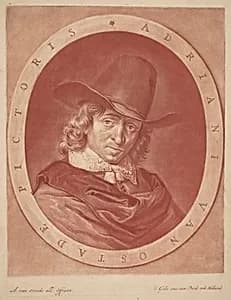
Adriaen van Ostade
Medium
mezzotint in red on laid paper
Dimensions
plate: 23 x 17.2 cm (9 1/16 x 6 3/4 in.) sheet: 27.2 x 21.5 cm (10 11/16 x 8 7/16 in.)
Classification
Department
CG-E
Museum
National Gallery of Art, Washington, D.C.
Credit
Ailsa Mellon Bruce Fund
Accession Number
2002.39.2
Rights
Public Domain
Art Historical Context
This striking mezzotint print, *Adriaen van Ostade*, a sensitive reproduction created by Dutch engraver Jacob Gole after a work by the renowned artist Adriaen van Ost (1610–1685). Produced around 1700, well after Ostade's death, it likely captures a portrait of the master himself, celebrating his legacy during the Dutch Golden Age. Ostade, a Haarlem-based painter, gained fame for his vivid genre scenes of peasants and everyday life, blending humor, realism, and Baroque drama in works that humanized the lower classes. The medium—a mezzotint in red ink on laid paper—highlights innovative 17th-century printmaking techniques. Mezzotint, pioneered by Ludwig von Siegen around 1642, involves roughening a copper plate to hold ink, then scraping highlights for luminous tonal gradations, yielding velvety textures ideal for portraits. The rare red ink adds warmth and richness, while laid paper's textured surface evokes the era's artisanal quality. At 23 x 17.2 cm (plate), it's intimate, perfect for collectors. Housed in the National Gallery of Art's Department of Prints (acquired via the Ailsa Mellon Bruce Fund), this piece underscores the era's booming print market, which democratized art by reproducing originals for wider audiences. It invites visitors to appreciate how Gole's technical mastery preserved Ostade's earthy spirit for generations.