
Adult Funeral Procession
1870s
Medium
Oil on slate paper
Dimensions
6 x 9 1/4 in. (15.2 x 23.5 cm)
Classification
Painting
Culture
American
Department
The American Wing
Museum
Metropolitan Museum of Art, New York, NY
Credit
The Edward W. C. Arnold Collection of New York Prints, Maps, and Pictures, Bequest of Edward W. C. Arnold, 1954
Accession Number
54.90.489
Rights
Public Domain
Tags
About this artwork
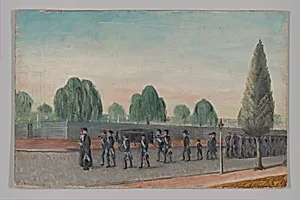
William P. Chappel's "Adult Funeral Procession" (1870s) represents the artist's extraordinary project of documenting early 19th-century New York City life from memory six decades later. Chappel (1801-1878), a New York tinsmith, painted nearly thirty scenes in the 1870s depicting his childhood city, creating an invaluable visual record of 1800s-1810s urban customs, architecture, and daily activities. This oil on slate paper (6 x 9 1/4 inches) depicts an 1807 funeral procession with minister, wido...
Art Historical Context
William P. Chappel's *Adult Funeral Procession*1870s), a petite oil on slate paper measuring just 6 x 9¼ inches, captures a solemn 1807 funeral march through early 19th-century New City. Painted from memory by the tinsmith-turned-artist (1801–1878), it shows a minister leading a widower and his son, flanked by mourners and pallers marked by white sashes and—precise details of urban mourning rituals. As one of nearly thirty scenes in Chappel's remarkable late-career project, it revives the streets, architecture, and daily customs of 1800s–1810s Lower Manhattan, a world erased by rapid urban growth. Chappel's work blends folk art's straightforward charm with astonishing topographical precision; Met scholars have mapped nearly all his scenes onto an 1808 city plan, confirming their fidelity to real locations and buildings. The unusual slate paper medium lends a tactile, archival quality, underscoring his role as a self-taught visual historian. He documented both adult and infant funerals, highlighting social hierarchies through procession order, clothing, and ritual objects like trees lining the route. Housed in the Metropolitan Museum of Art's American Wing as part of the Edward W. C. Arnold Collection (bequeathed 1954), this painting joins prints, maps, and pictures chronicling New York's transformation. It beautifully illustrates how personal recollection can preserve lost histories, offering visitors a vivid window into vanished American urban life.
About the Artist
William P. Chappel · 1801–1878
American, 1801–1878