
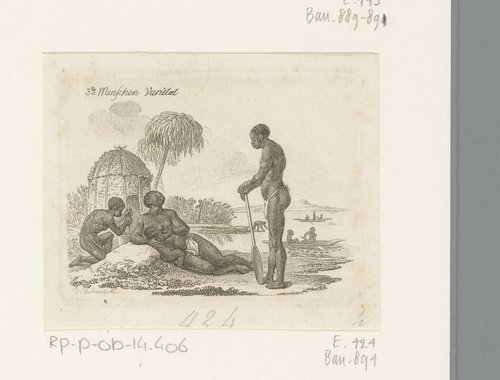
Afrikaans gezin
Medium
etching
Dimensions
55; 73
Rights
Public Domain
About this artwork
collector's mark: Lugt 2228
Art Historical Context
Daniel Nikolaus Chodowie, a prolific Polish-German artist and engraver active in 18th-century Berlin, created *Afrikaans gezin* 1782. This intimate etching, measuring just 55mm high by 73mm wide, exemplifies Chodowiecki's mastery of miniature-scale printmaking. Renowned for his thousands of illustrations depicting everyday life, social customs, and moral vignettes the Rococo style transitioning to Neoclassicism, he often produced works for books and periodicals, making art accessible to a wide audience. The title, translating to "Afrikaans family" from the Dutch-related language spoken by settlers in South Africa's Cape Colony, hints at a rare European artistic glimpse into colonial life during the Dutch East India Company's era. Created amid growing European fascination with distant cultures and exploration, the print likely captures a family portrait or genre scene, reflecting period interest in ethnography and global trade routes. Its small format was ideal for inclusion in travelogues or costume books, disseminating such imagery broadly. Etching's technique—biting acid into a metal plate for precise, expressive lines—suited Chodowiecki's detailed narrative style, allowing rich textures in clothing and expressions within tiny dimensions. Bearing the collector's mark Lugt 2228, this piece underscores its value in historical collections, offering visitors a window into 18th-century cross-cultural curiosity.
About the Artist
Daniel Nikolaus Chodowiecki · 1726–1801
Daniel Nikolaus Chodowiecki (1726–1801) was a German painter and printmaker of Polish-Huguenot descent who became the most celebrated graphic artist in 18th-century Germany. Born in Danzig (now Gdańsk), he created approximately 2,000 etchings that serve as an invaluable visual record of German bourgeois life during the Enlightenment. Largely self-taught, Chodowiecki moved to Berlin in 1743 and ach...