
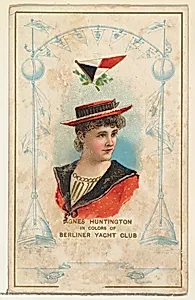
Agnes Huntington in Colors of the Berliner Yach Club, from the Yacht Colors of the World series (N140) issued by Duke Sons & Co. to promote Honest Long Cut Tobacco
Medium
Commercial color lithograph
Dimensions
Sheet: 4 in. × 2 1/2 in. (10.1 × 6.3 cm)
Classification
Prints|Ephemera
Department
Drawings and Prints
Museum
Metropolitan Museum of Art, New York, NY
Credit
The Jefferson R. Burdick Collection, Gift of Jefferson R. Burdick
Accession Number
63.350.207.140.48
Rights
Public Domain
Tags
Art Historical Context
Step into the vibrant world of 1890s advertising with this petite commercial color lithograph,Agnes Huntington in Colors of theer Yacht Club*, from the *Y Colors of the World* series (N140). Issued by W. Duke Sons & Co. to their Honest Long Cut Tobacco, it a portrait of Agnes Huntingtonlikely a celebrated figure of the era—adorned in the flag colors of Berlin's prestigious yacht club. just 4 × 2½ inches, this ephemera card was designed for collectors, tucked into tobacco packages to entice enthusiasts with glamorous imagery blending celebrity, nautical pride, and international flair. Chromolithography, the medium here, revolutionized commercial printing in the late 19th century, allowing vivid, multi-color reproductions at low cost. This technique captures the club's flag motifs with striking precision, highlighting the era's obsession with yachting as a symbol of elite leisure and global connectivity. Produced during a tobacco trade card boom, these inserts turned everyday products into coveted collectibles, reflecting America's growing consumer culture and fascination with European sophistication. Housed in the Metropolitan Museum of Art's Drawings and Prints department, thanks to the Jefferson R. Burdick Collection, this card offers a window into Gilded Age ephemera—where art met commerce, and a simple smoke became a passport to worldly adventures.
About the Artist
W. Duke, Sons & Co. · 1870–1920
**W. Duke, Sons & Co.: Pioneers of Chromolithographic Trade Card Art** W. Duke, Sons & Co., an American tobacco manufacturer, emerged from the entrepreneurial vision of Washington Duke (1820–1905) and his sons in Durham, North Carolina. After the Civil War, Washington abandoned farming in 1874 to join his eldest son, Brodie L. Duke, in the burgeoning tobacco trade, establishing a factory that for...