
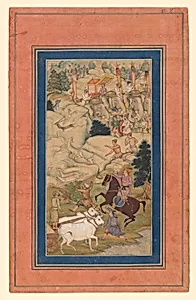
"Akbar Hunting with Cheetahs", Folio from a Manuscript of the Akbarnama. Folio from the Davis Album
ca. 1604
Medium
Ink, opaque watercolor, and gold on paper
Dimensions
Page: H. 13 1/8 in. (33.3 cm) W. 8 1/4 in. (21 cm) Mat: H. 19 1/4 in. (48.9 cm) W. 14 1/4 in. (36.2 cm)
Classification
Codices
Department
Islamic Art
Museum
Metropolitan Museum of Art, New York, NY
Credit
Theodore M. Davis Collection, Bequest of Theodore M. Davis, 1915
Accession Number
30.95.174.9
Rights
Public Domain
Tags
Art Historical Context
Behold the vibrant folio *"Akbar Hunting with Cheahs"* from the *Akbarnama*, the grand official biography of Mughal Emperor Akbar (r. 1556–1605). Created around 1604 by the skilled painter Manohar, with text by the emperor's court chronicler Abu'l Fazl, page captures a thrilling imperial hunt. Part of the Davis Album at the Metropolitan Museum of Art it exemplifies the pinnacle of Mughal miniature painting, Persian influences with Indian dynamism. Rendered in ink, opaque watercolor, and gold on paper (13 1/8 x 8 1/4 inches), the artwork bursts with meticulous detail. Manohar's fine ink outlines define leaping cheetahs—trained royal hunters—pursuing deer amid a lively entourage of men on horseback and elephant, plus grazing cows. The flat, vivid colors and gold highlights create a jewel-like quality, characteristic of the Mughal atelier's precision and narrative flair, where hunts symbolized the emperor's prowess and harmony with nature. This piece offers a window into Akbar's reign, a golden age of cultural synthesis and patronage. Hunting scenes like this celebrated imperial might while showcasing the cheetah's historical role in South Asian nobility, a tradition fading by the 20th century. A treasure of the Met's Islamic Art collection, it invites you to step into the splendor of 17th-century India.