
Album of Copies of Chinese Paintings
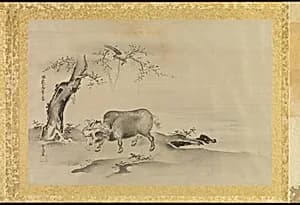
Medium
Album of thirty paintings; ink and color on silk
Dimensions
11 7/16 x 16 3/4 in. (29 x 42.5 cm)
Classification
Paintings
Culture & Period
Japan · Edo period (1615–1868)
Department
Asian Art
Museum
Metropolitan Museum of Art, New York, NY
Credit
Gift of Mr. and Mrs. Harry Rubin, 1972
Accession Number
1972.213.1–.30
Rights
Public Domain
Tags
Art Historical Context
This elegant album of thirty paintings, created in Japan during the Edo period, offers a fascinating window into the enduring dialogue between Japanese and Chinese artistic traditions. Compiled in the 17th century, it features copies after renowned Chinese masters such as Muqi, Guo Xi, and Zhao Mengfu, whose works spanned Song and Yuan dynasties. Executed in ink and color on silk, the compact format—each leaf measuring roughly 11 by 17 inches—allowed collectors to study and appreciate these interpretations in an intimate, portable way, reflecting the high regard for Chinese painting among Japanese connoisseurs. The inclusion of Kano Tsunenobu, a leading figure of the Kano school, alongside attributions to earlier Chinese artists underscores the album’s role in transmitting and adapting continental styles. Themes such as water buffaloes, a motif often linked to Zen Buddhist ideas of harmony and enlightenment, appear prominently, blending technical precision with expressive brushwork. Such albums served both as teaching tools and treasured objects, preserving visual knowledge across cultures. Housed today at The Metropolitan Museum of Art, this gift from Mr. and Mrs. Harry Rubin highlights the Edo period’s vibrant exchange of ideas, where Japanese artists reinterpreted Chinese masterpieces to create something uniquely their own.