
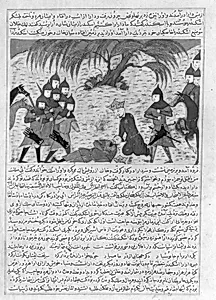
"Alexander the Great and Dying Darius", Folio from a Majma' al-Tavarikh (Compendium of Histories) of Hafiz-i Abru
ca. 1425
Medium
Opaque watercolor, silver, and gold on brownish paper
Dimensions
H. 17 in. (43.2 cm) W. 13 in. (33 cm)
Classification
Codices
Department
Islamic Art
Museum
Metropolitan Museum of Art, New York, NY
Credit
Purchase, Joseph Pulitzer Bequest, 1952
Accession Number
52.20.3
Rights
Public Domain
Tags
Art Historical Context
Behold the poignant scene of *Alexander the Great and Dying*, a folio from Hafiz-i Abru's *Majma' al-Tavarikh* (Compendium Histories), crafted around 1425 during the Timurid renaissance in Persia. This illuminated manuscript page captures a legendary moment from Alexander's conquests: the Macedonian king discovering the mortally wounded Persian ruler Darius III, a tale drawn from ancient chronicles romanticized in Islamic lore. Hafiz-i Abru, a renowned Timurid historian and illustrator, blended meticulous scholarship with artistry, making this compendium a treasure of 15th-century Persian historiography. Rendered in opaque watercolor, silver, and gold on brownish paper, the work exemplifies Persian miniature painting's luminous techniques. Vivid hues and metallic accents bring dynamic figures—Alexander on horseback, flanked by warriors and steeds—to life, emphasizing chivalry and pathos amid battle's chaos. The large format (17 x 13 inches) allowed for intricate details, showcasing the era's mastery of flat, patterned compositions that prioritize narrative over realism. Housed in the Metropolitan Museum of Art's Islamic Art collection, this folio highlights the cultural reverence for Iskandar (Alexander) as a philosopher-king in Persian-Islamic tradition, bridging Greco-Roman epics with Timurid ideals of just rule. A window into medieval storytelling, it invites us to ponder conquest's human cost.