
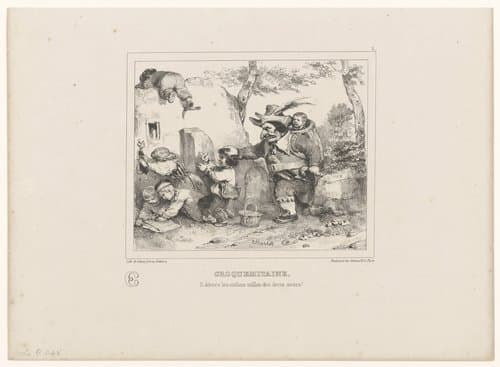
Alfabet met een moraal voor kinderen
Medium
lithography
Dimensions
246; 338
Rights
Public Domain
About this artwork
blad: hoogte 246 mm x breedte 338 mm
Art Historical Context
**Alfabet met een moraal voor kinderen (Alphabet with a Moral for Children)**, created by French artist Nicolas Toussaint Charlet in 1835, is a charming lithograph measuring 246 mm high by 338 mm wide. Charlet, a master of Romantic-era lithography renowned for his lively depictions ofonic soldiers and everyday French life, turned his satirical eye to children's education here. This print likely features an illustrated alphabet where each letter introduces a moral lesson through whimsical vignettes, blending learning with virtue in a format popular for young audiences. Lithography, Charlet's preferred medium, allowed for detailed, reproducible images at affordable prices, revolutionizing 19th-century illustration. During France's July Monarchy, such didactic works reflected a growing emphasis on moral instruction amid social change, making complex ideas accessible to the masses. Charlet's caricatural style—humorous, expressive, and infused with military flair—infuses the alphabet with energy, turning rote learning into engaging storytelling. This piece highlights lithography's cultural role in democratizing art and education, preserving a snapshot of 1830s childhood ideals. Visitors will appreciate its blend of playfulness and pedagogy, a testament to Charlet's versatility beyond battle scenes.
About the Artist
Nicolas Toussaint Charlet · 1792–1845
Comment on works: genre