
Alfred and Kitty Stieglitz
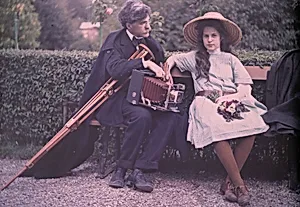
Medium
Autochrome
Dimensions
image: 11.3 × 16.5 cm (4 7/16 × 6 1/2 in.) overall: 12.9 × 18 cm (5 1/16 × 7 1/16 in.)
Classification
Photograph
Department
CPH
Museum
National Gallery of Art, Washington, D.C.
Credit
Alfred Stieglitz Collection
Accession Number
1949.3.290
Rights
Public Domain
Art Historical Context
In 1907, pioneering photographer Alfred Stiegl captured a tender moment with his daughter, Kitty (Katherine), in this rare early color photograph, possibly with assistance from fellow photographer Edward Steichen. Titled *Alfred and Kitty Stieitz*, the intimate portrait showcases father and child in a relaxed pose, highlighting Stieglitz's personal life amid his revolutionary work elevating photography to fine art. Housed in the National Gallery of Art's Alfred Stieglitz Collection it measures a modest 11.3 × 16.5 cm, inviting close contemplation of its subtle hues. The image's medium, Autochrome, marks a historic breakthrough—the Lumière brothers' patented process, commercially launched in 1907, was the first practical method for color photography. Unlike black-and-white prints, Autochrome used potato starch grains dyed red, green, and blue to create luminous, translucent colors when projected or viewed against light. This plate exemplifies the technique's delicate, painterly quality, bridging painting and photography during the Photo-Secession movement, which Stieglitz championed. As one of the earliest Autochromes by Stieglitz, it underscores his experimental spirit and the era's excitement over color's potential, transforming snapshots into artistic expressions of everyday beauty and familial warmth. Visitors will appreciate how this small gem captures a pivotal moment in photographic history.