
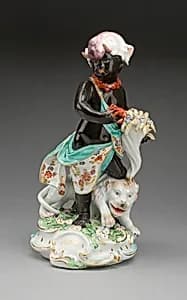
Allegorical Figure of Africa
1770/80
Medium
Soft-paste porcelain with polychrome enamels and gilding
Dimensions
Basediam: Diam.: 12 cm (4 3/4 in.); H.: 25.1 cm (9 7/8 in.)
Classification
sculpture
Department
Applied Arts of Europe
Museum
Art Institute of Chicago
Accession Number
129397
Rights
Public Domain
Art Historical Context
Step into the opulent world of 18th-century English porcelain with the *Allegorical Figure of Africa*, crafted by the renowned Derby Porcelain Manufactory around 1770–80. Standing at nearly 10 inches tall on a 4¾-inch base, this soft-paste porcelain sculpture exemplifies the factory's mastery during its golden Chelsea-Derby era. Derby, founded in 1750, rivaled continental leaders like Meissen and Sèvres, producing finely detailed figures for the elite homes of Georgian England. Personifying the continent of Africa—a popular motif in European decorative arts—this figure reflects the Enlightenment-era fascination with global exploration and colonial trade. Often adorned with exotic symbols in such works, it embodies the era's blend of curiosity and Eurocentric views, celebrating Britain's expanding empire. The use of soft-paste porcelain, a fragile yet translucent formula perfected by English makers before true hard-paste dominated, allowed for intricate modeling of drapery and features. Vibrant polychrome enamels and lavish gilding bring the figure to life, showcasing advanced firing techniques that ensured durability and luster. Housed in the Art Institute of Chicago's Department of Applied Arts of Europe, this piece highlights porcelain's evolution from luxury import to national artistry, inviting visitors to ponder the cultural exchanges—and stereotypes—of the age.
About the Artist
Derby Porcelain Manufactory · 1751–1785
The Derby Porcelain Manufactory stands as one of the foundational institutions of British ceramic art, producing some of the finest figures and tablewares made in England during the eighteenth and early nineteenth centuries. Its origins can be traced to the work of André Planché, a Huguenot immigrant from Saxony who settled in Derby around 1745 and began producing soft-paste porcelain figures and ...