
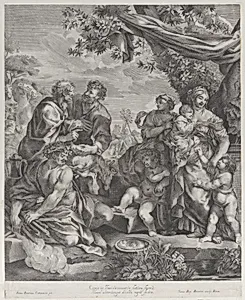
Allegorical scene with a sacrificial lamb
Medium
Etching and engraving
Dimensions
Sheet (Trimmed): 13 3/4 × 11 1/8 in. (35 × 28.3 cm)
Classification
Prints
Department
Drawings and Prints
Museum
Metropolitan Museum of Art, New York, NY
Credit
The Elisha Whittelsey Collection, The Elisha Whittelsey Fund, 1962
Accession Number
62.650.539
Rights
Public Domain
Art Historical Context
In the grand tradition of Baroque art, *Allegorical Scene with a Sacrificial Lamb* (1640–70) unites the visionary designs of Pietro da Cortona (Pietro Berrettini), a leading Roman painter and architect, with the masterful printmaking of Giovanni Battista Bonacina.ona, celebrated for his dramatic frescoes in palaces like the Barberini, infused this work with the era's theatrical energy—swirling drapery, emotive figures, and profound religious symbolism. The central sacrificial lamb evokes Christian iconography, symbolizing innocence, redemption, and Christ's ultimate sacrifice, a motif resonant during the Counter-Reformation's push for visual piety. Crafted as an etching and engraving on a modestly sized trimmed sheet (13 3/4 × 11 1/8 in.), this print exemplifies 17th-century reproductive techniques. Etching allowed Cortona's fluid, expressive lines to shine through Bonacina's precise burin work, making high-art compositions accessible beyond elite patrons. Housed in the Metropolitan Museum of Art's Drawings and Prints department (The Elisha Whittelsey Collection, 1962), it highlights printmaking's role in disseminating Baroque grandeur across Europe. This piece invites visitors to ponder allegory's power: a lamb's quiet vulnerability amid dynamic forms, bridging divine mystery and human devotion in an age of artistic splendor.
About the Artist
Giovanni Battista Bonacina|Pietro da Cortona (Pietro Berrettini) (Italian|Italian) · 1636 |1620 –1702 |1670
Milan 1636–1702 Milan|Italian, Milan 1620–ca. 1670