
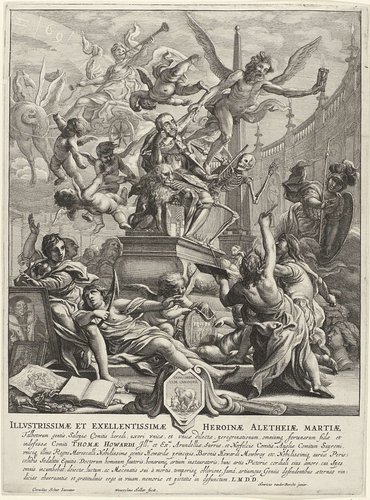
Allegorie op de dood van Thomas Howard
Medium
etching
Dimensions
437; 322
Rights
Public Domain
About this artwork
plaatrand: hoogte 437 mm x breedte 322 mm
Art Historical Context
Wenceslaus Hollar's *Allegorie op de dood Thomas Howard* (1646) is a poignant etching created in the year of the English Civil War's turmoil, mourning the death of Howard, 2nd Earl of Arund—a renowned art patron and collector who had employed Hollar as personal artist. Measuring 437 mm high by 322 mm wide, this large plate captures an allegorical tribute, blending Baroque symbolism with meticulous detail to honor Howard's legacy as a guardian of classical antiquities and Renaissance treasures. As a master etcher active across Europe, Hollar excelled in the intricate technique of etching, using acid to bite fine lines into copper plates for reproductions of exceptional clarity and depth. This medium allowed wide dissemination of his work, making elite commemorations accessible to a broader audience. Hollar's style, rooted in the detailed realism of 17th-century printmaking, reflects his training in Antwerp and his time in England, where he documented architecture, portraits, and natural history with unparalleled precision. This artwork holds cultural significance as a personal elegy from artist to patron, encapsulating the era's aristocratic fascination with mortality and legacy amid political upheaval. Visitors will appreciate its technical virtuosity and emotional resonance, a testament to Hollar's enduring influence on British graphic arts.
About the Artist
Wenceslaus Hollar · 1607–1677
Wenceslaus Hollar (1607-1677) was a prolific Bohemian etcher who became one of the most accomplished printmakers of the seventeenth century. Born in Prague, he trained under Matthäus Merian in Frankfurt before entering the service of Thomas Howard, Earl of Arundel, in 1636. Hollar spent most of his career in England, where he produced approximately 2,740 etchings documenting an extraordinary range...