
Allegorie op het Romeinse Rijk
1726
Medium
engraving
Dimensions
148; 85
Rights
Public Domain
About this artwork
gravure en ets
Art Historical Context
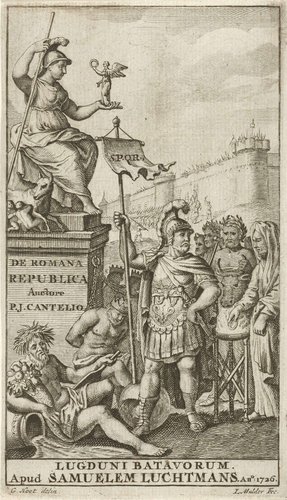
Created in 1726 by Dutch engraver Joseph Mulder, *Allegorie op het Romeinse Rijk* is a compact print measuring just 148 by 85 millimeters. Executed in engraving and etching, the work exemplifies the refined reproductive techniques popular in the Netherlands during the early eighteenth century. Such small-scale prints were often made for book illustrations, private collections, or as independent allegorical images that circulated widely among educated viewers. The title indicates an allegorical treatment of the Roman Empire, a theme that allowed artists to explore ideas of power, virtue, and decline through symbolic figures and classical motifs. Mulder’s precise line work would have captured intricate details, lending both visual clarity and intellectual depth to the composition. In an era of renewed interest in antiquity, this engraving reflects how classical history continued to inspire moral and political reflection in European art. Though modest in size, the print demonstrates the enduring cultural role of graphic media in disseminating complex ideas. Its combination of engraving and etching highlights the technical sophistication of Dutch printmakers, whose works bridged fine art and accessible knowledge for a growing audience.
About the Artist
Joseph Mulder · 1659–1718
Joseph Mulder (1659/1660–1710 or later) was a renowned Dutch Golden Age printmaker whose work exemplifies the sophisticated reproductive engraving practiced in Amsterdam during the late seventeenth and early eighteenth centuries. Trained under notable masters including Bogaert and influenced by Romeyn de Hooghe, Mulder achieved particular distinction for his scientific illustrations, most notably ...