
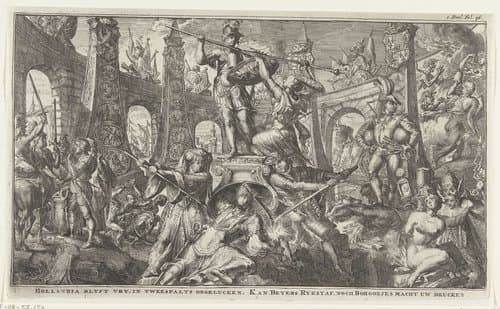
Allegorie rond de strijd met Beieren en Bourgondië
1704 - 1706
Medium
etching
Dimensions
180; 298
Rights
Public Domain
About this artwork
Illustratie voor: E. van der Hoeven, Hollands aeloude vryheid, buyten het stadhouderschap, J. ten Hoorn, Amsterdam 1706, p. 76.
Art Historical Context
This etching by Romeyn de Hooghe, created between 1704 and 1706, served as an illustration for E. van der Hoeven’s political treatise *Hollands aeloude vryheid, buyten het stadhouderschap* (Holland’s Ancient Freedom, Outside the Stadtholderate). The work visually captures the Dutch Republic’s enduring struggle to preserve its republican liberties against external powers, specifically referencing historical conflicts involving Bavaria Burgundy. De Hooghe, a leading Dutch printmaker of the late Golden Age, specialized in intricate allegorical scenes that blended myth, history, and contemporary politics to comment on the nation’s independence. Executed in etching—a medium prized for its sharp lines and capacity to convey dramatic detail—the composition likely personifies Holland’s freedom triumphing over foreign domination through symbolic figures and emblematic motifs. Published in Amsterdam just four years after the death of Stadtholder William III, the image reinforced contemporary debates about governance without a hereditary ruler. De Hooghe’s dynamic style made complex political arguments accessible to a broad readership, underscoring the power of printed imagery in shaping public discourse during the early Enlightenment.
About the Artist
Romeyn de Hooghe · 1645–1708
Romeyn de Hooghe (1645-1708) was a Dutch Baroque engraver, draughtsman, and political satirist who became the most prolific and versatile graphic artist of the Dutch Republic in the late seventeenth century. Born in Amsterdam, he rose to become one of early modern Europe's most important printmakers and a pioneering master of political satire. De Hooghe's significance extends far beyond his techn...