
Allegories of America, Asia, and Europe
18th century
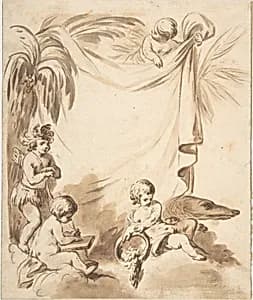
Medium
Brush and brown wash on paper
Dimensions
7 3/8 x 6 3/16 in. (18.7 x 15.7 cm)
Classification
Drawings
Department
Drawings and Prints
Museum
Metropolitan Museum of Art, New York, NY
Credit
Gift of the Estate of James Hazen Hyde, 1959
Accession Number
59.208.99
Rights
Public Domain
Tags
Art Historical Context
This delicate 18th-century French, *Allegories of America,, and Europe*, captures era's fascination with global exploration and cultural symbolism through personified continents. Created anonymously using brush and brown wash on paper—a technique favored for its fluid, tonal expressiveness—this intimate work (just 7 3/8 x 6 3/16 inches) likely served as a preparatory study or standalone sketch. The inclusion of children and animals as suggested by its motifs, evokes the Rococo penchant for playful yet emblematic vignettes, where youthful figures and beasts represent the "spirits" or attributes of distant lands. In the Enlightenment Age of Louis XV's France, such allegories reflected Europe's expanding worldview amid colonial ventures and trade. America might symbolize untamed wilderness, Asia exotic riches, and Europe refined civilization—common tropes in decorative arts, maps, and prints. The brown wash lends a soft, atmospheric depth, highlighting contours and evoking mystery in these compact scenes. Now housed in the Metropolitan Museum of Art's Drawings and Prints department, gifted from the Estate of James Hazen Hyde in 1959, this piece offers a window into anonymous artistic ingenuity, reminding us how everyday sketches preserved grand imperial dreams.
About the Artist
Anonymous, French, 18th century · 1700–1800
The artist known as Anonymous, French, 18th century, represents a collective of unidentified talents active roughly between 1700 and 1800, a period of profound artistic evolution in France from the opulent Rococo to the austere dawn of Neoclassicism and Revolutionary fervor. Little is documented about their personal training or mentors, as their anonymity obscures individual biographies, though th...