
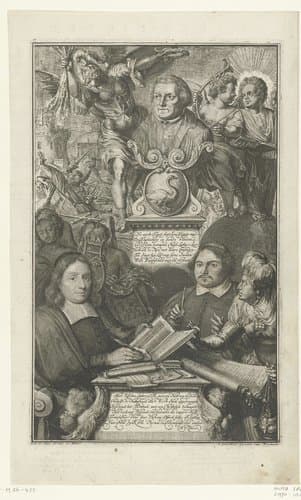
Allegorische voorstelling met Maarten Luther
1703
Medium
etching
Dimensions
189; 332
Rights
Public Domain
About this artwork
ets en gravure
Art Historical Context
Behold *Allegorische voorstelling met Maarten Luther*1703), a striking etching and engraving by the prolific Dutch artist Romeyn de Hooghe. Measuring 332 mm high by 189 mm wide, this print exemplifies de Hooghe's mastery of Baroque printmaking during the Dutch Golden Age's twilight. De Hooghe, a versatile figure known for his satirical illustrations, propaganda, and emblematic designs, blended etching's fluid, spontaneous lines with engraving's crisp precision to create dynamic compositions rich in detail and symbolism. Created over 150 years after Martin Luther's Ninety-Five Theses ignited the Protestant Reformation, this allegorical depiction likely honors the reformer amid ongoing religious and political tensions in the Netherlands. By 1703, the Dutch Republic was a Protestant stronghold, and such prints served as visual propaganda, reinforcing Reformation ideals through allegory—personifications of virtues, vices, or historical events swirling around Luther's central figure. The mixed technique highlights de Hooghe's innovative approach: etching for expressive shading and texture, engraving for fine lines that ensured durability in mass production. This affordable medium made complex ideas accessible, educating and inspiring viewers in homes and taverns. A testament to printmaking's cultural power, it invites us to ponder faith, reform, and artistry's role in shaping history.
About the Artist
Romeyn de Hooghe · 1645–1708
Romeyn de Hooghe (1645-1708) was a Dutch Baroque engraver, draughtsman, and political satirist who became the most prolific and versatile graphic artist of the Dutch Republic in the late seventeenth century. Born in Amsterdam, he rose to become one of early modern Europe's most important printmakers and a pioneering master of political satire. De Hooghe's significance extends far beyond his techn...