
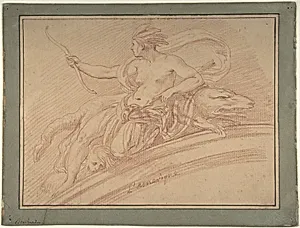
Allegory of America, from the Four Continents
18th century
Medium
Red chalk
Dimensions
10 x 13 1/2 in. (25.4 x 34.3 cm)
Classification
Drawings
Department
Drawings and Prints
Museum
Metropolitan Museum of Art, New York, NY
Credit
Gift of the Estate of James Hazen Hyde, 1959
Accession Number
59.208.91
Rights
Public Domain
Tags
Art Historical Context
Edme Bouchardon's "Allegory of America" forms part of a series depicting the Four Continents, a popular theme in 18th-century European art that reflected the era's fascination with global exploration and cultural encounters. As a French sculptor and draftsman active during the transition from Baroque to Neoclassical styles, Bouchardon brought elegance and clarity to such symbolic subjects, capturing the spirit of discovery through refined draftsmanship. Executed in red chalk, this drawing showcases the medium's warm tonal range and fluid lines, which allow for subtle modeling of forms and expressive detail. The work's modest scale—roughly 10 by 13½ inches—suggests it may have served as a preparatory study or presentation piece, highlighting Bouchardon's skill in conveying narrative through economical means. Housed in the Metropolitan Museum of Art, the piece offers viewers insight into how Enlightenment-era artists visualized distant lands, using allegory to blend observation with imagination. Its inclusion in the museum's Drawings and Prints collection underscores the enduring appeal of these continental personifications as windows into historical worldviews.
About the Artist
Edme Bouchardon · 1698–1762
Born 29 May 1698; died 27 July 1762. Bouchardon was a student of Guillaume Coustou, and won the prix de Rome in 1722. He spent ten years (1722-1732) in Rome, Italy working on various projects for Pope Clement XII. In 1732 Bouchardon was recalled to Paris and named sculptor to the king. Bouchardon became a professor at the Académie Royale in 1746. He worked on an equestrian monument of Louis XV, Ki...