
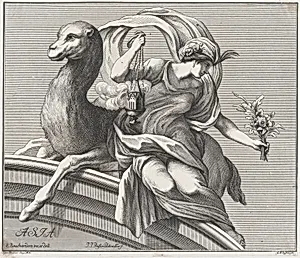
Allegory of Asia, from the Four Continents
Medium
Engraving
Dimensions
Sheet (trimmed): 11 1/8 × 12 15/16 in. (28.2 × 32.8 cm)
Classification
Prints
Department
Drawings and Prints
Museum
Metropolitan Museum of Art, New York, NY
Credit
Harris Brisbane Dick Fund, 1953
Accession Number
53.600.2410
Rights
Public Domain
Tags
Art Historical Context
"Allegory of Asia, the Four Continents" a captivating 1732 engraving created by the skilled German engravers Georg Martin Preissler Johann Justin Preissler after a design by the French sculptor Edme Bouchardon. Measuring about 11 by 13 inches, this print from the Metropolitan Museum of Art Drawings and Prints collection vividly personifies Asia through elegant female figures, majestic camels, and ornate censers billowing incense. As part of a popular 18th-century series allegorizing the four continents—Europe, Asia, Africa, and America—it reflects the era's fascination with global exploration and exoticism. Engravings like this one were revolutionary for their time, allowing intricate designs to be reproduced and distributed widely across Europe. Bouchardon's sculptural flair shines through in the dynamic poses and rich details, while the Preisslers' precise burin work captures textures from flowing robes to the camels' humps with remarkable fidelity. These symbols—camels evoking vast deserts and trade routes, censers nodding to Asia's incense traditions—embody Enlightenment ideals of categorizing the world, often through a Eurocentric lens that romanticized distant lands. This artwork invites us to ponder how 18th-century artists bridged art and empire, offering a window into the cultural imagination of the Rococo age. A true gem for print enthusiasts! (198 words)