
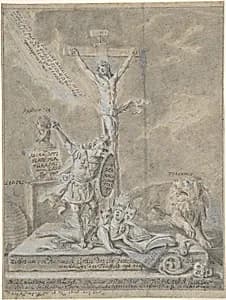
Allegory of Christian Virtues
Medium
Black chalk, gray wash, white bodycolour, on blue paper
Dimensions
sheet: 8 11/16 x 6 9/16 in. (22 x 16.6 cm)
Classification
Drawings
Department
Drawings and Prints
Museum
Metropolitan Museum of Art, New York, NY
Credit
Harry G. Sperling Fund, 2008
Accession Number
2008.496
Rights
Public Domain
Tags
Art Historical Context
Johann Elias Ridinger, a 18th-century German artist engraver from Augsburg, is celebrated for his intricate depictions of animals and dynamic hunting scenes, often infused with Baroque naturalism. Created in 1746, *Allegory of Christian Virtues* showcases his versatility in a more symbolic, religious vein. This intimate drawing on blue paper—measuring just 8 11/16 x 6 9/16 inches—employs black chalk for precise lines, gray wash for subtle shading, and white bodycolor for luminous highlights, techniques that evoke depth and drama on the tinted ground, a favored method among Rococo draftsmen for preparatory studies or standalone works. The composition allegorizes core Christian virtues through evocative motifs: noble lions symbolizing strength and resurrection, male figures embodying faith and fortitude, and references to the Crucifixion underscoring sacrifice and redemption. In the mid-18th century, such allegories served as moral guides amid Europe's religious art traditions, blending spiritual narrative with Ridinger's signature animal vitality—lions rendered with anatomical precision drawn from his expertise in equestrian and wildlife imagery. Acquired by The Metropolitan Museum of Art in 2008 through the Harry G. Sperling Fund, this drawing exemplifies Ridinger's printmaker roots, likely a design for etching. It invites visitors to ponder how everyday virtues triumph over adversity, captured in a masterful play of light and shadow.
About the Artist
Johann Elias Ridinger · 1698–1767
Johann Elias Ridinger (1698–1767) was born in Ulm into an artistic family, the son of scribe and artist Johann Daniel Ridinger and Regina Catharina Miller. He received his initial training in Ulm under the painter Christoph Resch, who instructed him in perspective, geometry, and architecture while assigning preparatory tasks like painting wax models. Around 1713, Ridinger moved to Augsburg, where ...