
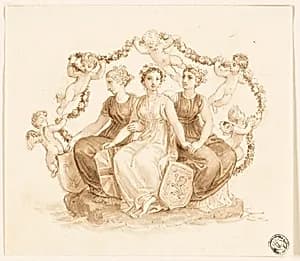
Allegory of England, Scotland, and Ireland
n.d.
Medium
Pen and brown ink with brush and brown wash, on ivory wove paper
Dimensions
12.7 × 14.6 cm (5 × 5 3/4 in.)
Classification
pen and ink drawings
Department
Prints and Drawings
Museum
Art Institute of Chicago
Accession Number
83426
Rights
Public Domain
Art Historical Context
Thomas Stothard's *Allegory of England,, and Ireland* is a delicate pen and brown ink drawing enhanced with brush and brown wash ivory wove paper, a compact 12.7 × 14.6 cm. Created by the prolific British artist (17551834), renowned for his neoclassical and Romantic illustrations, book designs, and history paintings, this undated work personifies the three nations in a harmonious tableau. Stothard, a favorite of Georgian patrons, often infused his compositions with poetic symbolism, blending elegance with narrative depth. The artwork likely reflects the early 19th-century fervor surrounding Britain's political unions—the 1707 Act uniting England and Scotland, and the 1801 union with Ireland. Such allegories were popular in British art to evoke national unity and imperial pride, showcasing draped female figures in classical attire, perhaps with emblems like roses, thistles, and shamrocks. Stothard's masterful use of ink lines for precise contours and translucent brown washes for subtle shading creates a luminous, ethereal effect, typical of his preparatory sketches for larger oils or engravings. Housed in the Art Institute of Chicago's Prints and Drawings department, this intimate piece highlights Stothard's versatility in monochrome media, bridging fine art and illustration. It invites visitors to ponder the era's blend of patriotism and artistry, a snapshot of cultural identity in flux.
About the Artist
Thomas Stothard · 1755–1834
Thomas Stothard RA (1755–1834) was born on 17 August 1755 at the Black Horse Inn in London's Long Acre, the son of a prosperous publican originally from Stutton near Tadcaster. A delicate child, he was sent at age five to relatives in Yorkshire, attending schools in Acomb, Tadcaster, and later Ilford, Essex, where he honed his drawing skills by copying prints. Following his father's death in 1770,...