
Allegory of the Revival of the Dutch Herring Fishery after the Second Anglo-Dutch War (1665-67)
c. 1667 - c. 1670
Medium
oil on canvas
Dimensions
163.2; 5; 114.3
Rights
Public Domain
About this artwork
…; ? collection Jonkheer Johan Cornelis de Jonge (1793-1853), The Hague;{R. van Luttervelt, ‘Herinneringen aan Michiel Adriaenszoon de Ruyter in het Rijksmuseum’, _Bulletin van het Rijksmuseum_ 5 (1957), pp. 28-70, esp. pp. 62-63.} ? his son, Jan Karel Jacob de Jonge (1828-1880), The Hague;{R. van Luttervelt, ‘Herinneringen aan Michiel Adriaenszoon de Ruyter in het Rijksmuseum’, _Bulletin van het Rijksmuseum_ 5 (1957), pp. 28-70, esp. pp. 62-63.} his wife, Jonkvrouw Elizabeth Adriana de Jonge, n...
Art Historical Context
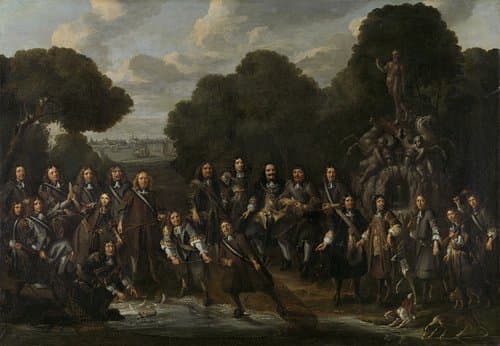
Willem Eversdijck's *Allegory of the Revival the Dutch Herring Fishery the Second Anglo-Dutch (1665-67)*, painted around 1667-1670, captures a triumphant moment in Dutch history. Created as an oil on canvas measuring 114.3 x 163.2 cm, this work belongs to the Dutch Golden Age, when maritime prowess and trade fueled national prosperity. The herring fishery was a cornerstone of the Dutch economy, the war with England severely disrupted it; Eversdijck's allegory symbolizes its postwar resurgence, blending patriotic pride with symbolic imagery typical of 17th-century Dutch Baroque art. Eversdijck, a Haarlem-based painter known for detailed genre and marine scenes, employs rich oils to evoke abundance and renewal—likely featuring fishing vessels, bountiful catches, and heroic figures amid a bustling North Sea backdrop. The painting's historical resonance lies in celebrating economic resilience amid naval victories, possibly alluding to Admiral Michiel de Ruyter, whose exploits are noted in its provenance. Now housed in the Rijksmuseum, the canvas has a colorful history: once misattributed to Hendrick Berckman and displayed as a portrait of de Ruyter, it passed through elite Dutch collections before a 1950 Paris sale brought it to Amsterdam. This allegorical gem reminds visitors of the Netherlands' seafaring legacy and artistic flair for turning trade triumphs into visual poetry.