
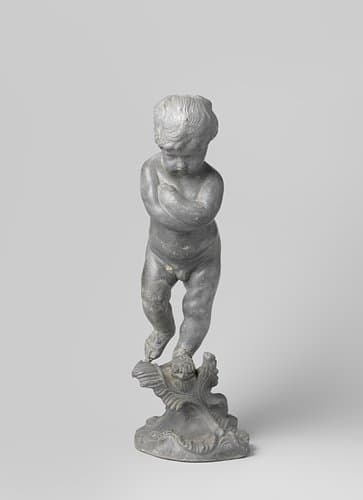
Allegory of Winter, from a Series of the Four Seasons
c. 1730 - c. 1750
Medium
lead with traces of paint
Dimensions
19; 16; 44; 7.5
Rights
Public Domain
About this artwork
…; unspecified private garden, Rotterdam;{Note RMA.} from the dealer F.J. Peters, Tilburg, with BK-16447-A to -C, fl. 1,200 for all four, to the museum, 1950
Art Historical Context
This lead sculpture, titled *Allegory of Winter* and created by the Larson workshop around 1730–1750, forms part of a four-piece series representing the seasons. Standing 44 cm tall and weighing 7.5 kg, the figure was designed as a garden ornament, its traces of original paint hinting at a once-vivid surface meant to withstand outdoor conditions. Lead’s malleability allowed artisans to capture fine details while keeping pieces light enough for placement in private estates. In 18th-century Europe, allegories of the seasons were popular decorative elements in formal gardens, evoking the rhythms of nature and the passage of time. Such works often blended classical symbolism with local tastes, turning estates into theaters of changing weather and agricultural cycles. This example’s modest scale suggests it was intended for intimate garden settings rather than grand public spaces. Acquired by the museum in 1950 from a private Rotterdam garden through dealer F.J. Peters, the sculpture offers visitors a glimpse into Dutch 18th-century domestic art. Its weathered surface and compact form remind us how these seasonal figures once animated everyday landscapes with quiet elegance.