
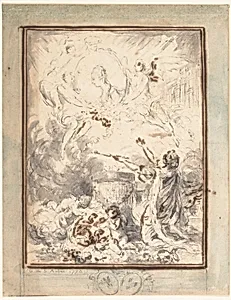
Allegory on the Marriage of the Dauphin and Marie-Antoinette in 1770
Medium
Brush and gray wash, accents in pen and brown ink, over black chalk. Framing lines in pen and brown ink; margins tinted with blue-green wash.
Dimensions
8 11/16 x 6 3/4 in. (22.1 x 17.1 cm)
Classification
Drawings
Department
Drawings and Prints
Museum
Metropolitan Museum of Art, New York, NY
Credit
Rogers Fund, 1937
Accession Number
37.165.106
Rights
Public Domain
Tags
Art Historical Context
Created in 1770 by French draftsman Gabriel de Saint-Aubin, this delicate drawing commemorates the politically momentous marriage of the future Louis XVI to the fourteen-year-old Archduchess Marie-Antoinette. The union, arranged to cement an alliance between France and Austria, was celebrated with lavish festivities across Paris; Saint-Aubin’s composition captures the event through allegory rather than literal reportage, allowing him to blend contemporary news with timeless symbolism. Executed in brush and gray wash heightened with pen and brown ink over black chalk, the sheet demonstrates Saint-Aubin’s characteristic lightness of touch and fluid handling of tone. The subtle blue-green wash that tints the margins frames the scene like a theatrical proscenium, guiding the viewer’s eye toward the central figures. Such wash drawings were prized in the eighteenth century for their ability to suggest both grandeur and intimacy on a small scale. Today in the Metropolitan Museum’s collection, the work offers modern visitors a vivid glimpse of how one observant artist transformed a royal wedding into an elegant meditation on diplomacy, youth, and destiny.
About the Artist
Gabriel de Saint-Aubin · 1724–1780
Gabriel de Saint-Aubin (1724–1780) was one of the most vivid and irrepressible graphic artists of eighteenth-century France, a tireless draughtsman whose sketchbooks and prints constitute an extraordinary visual chronicle of Parisian life during the Ancien Régime. Born into a family with strong connections to the decorative arts — his father was an embroiderer to the king — Saint-Aubin received fo...