
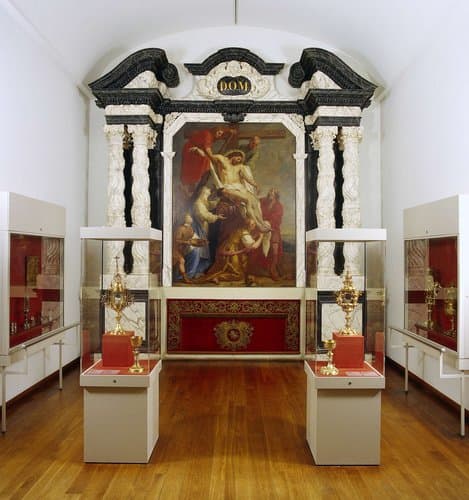
Altaar van de Rooms Katholieke kerk te Rijsbergen
c. 1625 - c. 1650
Medium
wood (plant material)
Dimensions
529; 451
Rights
Public Domain
About this artwork
height 529 cm x width 451 cm
Art Historical Context
Nestled in the Roman Catholic Church of Rijsbergen, a village in the Netherlands' Noord-Brabant region, this grand wooden altar stands as a testament to 17th-century religious devotion. Dating to approximately 1625–1650 and crafted by an anonymous artist, it measures an imposing 529 cm in height and 451 cm in width, dominating the sacred space with its monumental scale. Such altars were the focal point of Catholic worship, designed to inspire awe and draw the faithful toward the Eucharist. Created during the Baroque era amid the Counter-Reformation, the altar reflects the Catholic Church's efforts to reaffirm its presence in the Protestant-dominated Dutch Republic. Noord-Brabant remained a Catholic stronghold, where wooden altars like this one—carved from plant material—served as affordable yet expressive alternatives to stone or marble in local parishes. The anonymous craftsmanship highlights the collaborative tradition of church workshops, prioritizing spiritual symbolism over individual fame. Though details of its iconography are sparse, its survival underscores the enduring cultural importance of vernacular religious art. Visitors can imagine parishioners gathering before it during turbulent times, finding solace in its sturdy wooden form—a quiet survivor of history's religious divides.
About the Artist
anonymous
In the vast tapestry of art history, "Anonymous" stands not as a singular individual but as a collective designation for countless unidentified creators whose works have endured across millennia. These artists, spanning prehistoric cave painters to medieval illuminators and folk craftsmen, produced the foundational layers of human visual culture. Prior to the Renaissance, when individual fame emer...