
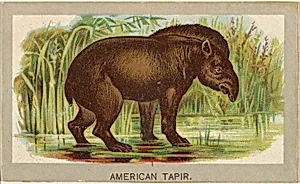
American Tapir, from the Animals of the World series (T180), issued by Abdul Cigarettes
1881
Medium
Commercial color lithograph
Dimensions
Sheet: 1 5/8 × 2 3/4 in. (4.2 × 7 cm)
Classification
Prints|Ephemera
Department
Drawings and Prints
Museum
Metropolitan Museum of Art, New York, NY
Credit
The Jefferson R. Burdick Collection, Gift of Jefferson R. Burdick
Accession Number
63.350.246.180.9
Rights
Public Domain
Tags
Art Historical Context
Step into the vibrant world of 19th-century ephemera with *American Tapir*, a gem from the *Animals of World* series (T), issued by Abdul Cig in 1881. This petite commercial color lithograph, just 1 5/8 × 2 3/4 inches, captures the distinctive, prehistoric-looking tapir—a shy, herbivorous mammal native to Central and America. Part of a popular tobacco trade card series, these inserts were tucked into cigarette packs to stiffen them and spark collecting fever among enthusiasts, blending education with everyday commerce. Chromolithography, the medium here, revolutionized mass-produced color printing in the late Victorian era. Multiple stones layered vivid hues onto paper, creating affordable, eye-catching illustrations that brought exotic wildlife to ordinary pockets. Abdul Cigarettes, like many tobacco firms, leveraged this technique to educate smokers on global fauna, reflecting a growing public fascination with natural history amid Darwin's influence and expanding zoos. Today, housed in The Metropolitan Museum of Art's Jefferson R. Burdick Collection—a treasure trove of over 30,000 cards gifted in 1948—this tiny print highlights ephemera's cultural role. Once disposable promotions, these cards now reveal consumer trends, printing innovations, and our enduring curiosity about the animal kingdom. A delightful reminder of how even the smallest artifacts pack historical punch!
About the Artist
Abdul Cigarettes · 1881–1881
Abdul Cigarettes, an enigmatic American entity active solely in 1881, stands as a fascinating footnote in the history of commercial art, best known for producing vibrant chromolithograph trade cards inserted into cigarette packages as promotional inserts. Little is documented about its origins or personnel, suggesting it operated as a short-lived publishing venture rather than the work of a singul...