
Amoenissimae Aliquot Locorum In Diversis Provincijs iacentiu Effigies
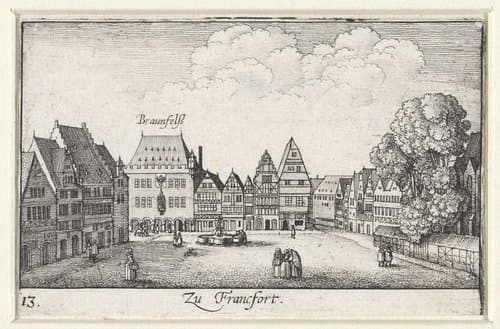
Medium
etching
Dimensions
60; 95
Rights
Public Domain
About this artwork
blad: hoogte 60 mm x breedte 95 mm
Art Historical Context
Wenceslaus Hollar, a prolific Bohemian etcher active in the 17th, created *Amoenissimae Aliquot Locorum In Diversis Provincijs iacent Effigies* in 1635, early in his distinguished career. This Latin-titled work, translating roughly to "The Most Pleasant of Certain Places in Various Provinces," exemplifies Hollar's talent for topographical views, capturing idyllic landscapes or architectural scenes from across Europe. At just 60mm high by 95mm wide, its miniature scale highlights the era's fascination with portable, detailed prints that brought distant locales to life for collectors and travelers. Etched with remarkable precision, the artwork showcases Hollar's mastery of the etching technique, where acid bites into a metal plate to produce intricate lines and textures. This medium allowed for subtle tonal variations and fine details—hallmarks of Baroque printmaking—making complex scenes feasible in such a compact format. Hollar, who later became one of England's foremost engravers after moving to London in 1637, drew from direct observation and emerging cartographic interests, blending art with documentation. Culturally, this piece reflects the 17th-century boom in printed vistas, fueled by exploration and the Grand Tour. It offered viewers a window into "amoenissimae" (most charming) provincial beauties, preserving ephemeral sights in enduring ink. A gem for print enthusiasts, it invites us to marvel at Hollar's ability to distill vast scenery into intimate artistry.
About the Artist
Wenceslaus Hollar · 1607–1677
Wenceslaus Hollar (1607-1677) was a prolific Bohemian etcher who became one of the most accomplished printmakers of the seventeenth century. Born in Prague, he trained under Matthäus Merian in Frankfurt before entering the service of Thomas Howard, Earl of Arundel, in 1636. Hollar spent most of his career in England, where he produced approximately 2,740 etchings documenting an extraordinary range...