
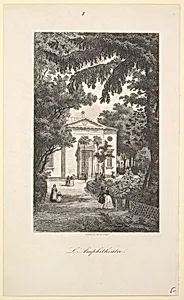
Amphitheater of the Botanical Gardens, Paris
Medium
Etching; second state of three (Delteil)
Dimensions
Image: 6 3/4 × 4 1/4 in. (17.1 × 10.8 cm) Sheet: 10 × 6 in. (25.4 × 15.2 cm)
Classification
Prints
Department
Drawings and Prints
Museum
Metropolitan Museum of Art, New York, NY
Credit
The Elisha Whittelsey Collection, The Elisha Whittelsey Fund, 1979
Accession Number
63.625.79
Rights
Public Domain
Tags
Art Historical Context
Step into the lush world of 19th-century Paris with Charles-François Daubigny's *Amphitheater of the Gardens, Paris* (1842), a delicate etching in its second state of three. intimate print, measuring just 6 3/4 × 4 1/4 inches, captures the elegant amphitheater nestled within the Jardin des Plantes, one Europe's oldest botanical gardens founded in 1626. Daubigny, then a young artist of 25, skillfully renders the garden's architectural harmony—curving stone tiers blending seamlessly with verdant surroundings—evoking the era's fascination with nature's ordered beauty amid urban growth. As a pioneer of the Barbizon school, Daubigny favored plein-air observation and loose, atmospheric effects that foreshadowed Impressionism, though this early etching showcases his precision in line work. Etching, created by incising a metal plate with acid, allowed for rich tonal variations and intricate details, from shadowed arches to leafy vignettes. The "second state" refers to a refined edition per Delteil's catalog, highlighting the iterative artistry of printmaking. Housed in the Metropolitan Museum of Art's Drawings and Prints department, this piece from The Elisha Whittelsey Collection invites us to appreciate how Daubigny transformed a Parisian landmark into a timeless study of light, structure, and serenity. A charming window into Romantic-era leisure and scientific curiosity!
About the Artist
Charles-François Daubigny · 1817–1878
Charles-François Daubigny was born on February 15, 1817, in Paris into a family of artists, with his father, Edmé-François Daubigny, a classical landscape painter, and his uncle, Pierre Daubigny, a miniaturist, providing his initial artistic training. He further studied under Jean-Victor Bertin, Jacques Raymond Brascassat, and Paul Delaroche at the École des Beaux-Arts, though he quickly moved bey...