
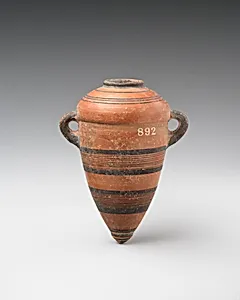
Amphoriskos
Unknown Artist
850–750 BCE
Medium
Terracotta
Dimensions
H. 5 3/16 in. (13.2 cm)
Classification
Vases
Culture & Period
Cypriot · Cypro-Geometric III
Department
Greek and Roman Art
Museum
Metropolitan Museum of Art, New York, NY
Credit
The Cesnola Collection, Purchased by subscription, 1874–76
Accession Number
74.51.891
Rights
Public Domain
Art Historical Context
This delicate amphoriskos, a small terracotta vase standing just over 5 inches tall, hails from Cyprus during the Cypro-Geometric III period (850–750 BCE).aped like a miniature amphora with a narrow neck and handles, it exemplifies the practical yet elegantly proportioned pottery of ancient Cypriot artisans. Crafted from fired clay, these vessels were ideal for storing precious oils, perfumes, or unguents, reflecting everyday life in a bustling island culture at the dawn of the Iron Age. In the Cypro-Geometric era, Cypriot pottery bridged influences from the Aegean, Near East, and local traditions, marked by simple geometric motifs and biconical forms. Though decoration details are minimal here, the amphoriskos embodies the period's shift toward more refined wheel-thrown techniques, signaling growing trade networks across the eastern Mediterranean. Its survival offers a window into Cyprus's role as a cultural crossroads. Acquired as part of the renowned Cesnola Collection—purchased by subscription between 1874 and 1876—this piece now graces the Metropolitan Museum of Art's Greek and Roman Art department, inviting visitors to ponder the ingenuity of unnamed ancient makers.