
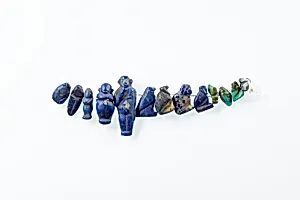
Amulet in the Form of a Falcon
Unknown Artist
ca. 1850–1775 B.C.
Medium
Lapis lazuli
Dimensions
H. 1.2 × W. 0.9 × D. 0.4 cm (1/2 × 3/8 × 3/16 in.)
Classification
Amulet, falcon
Period
Middle Kingdom
Department
Egyptian Art
Museum
Metropolitan Museum of Art, New York, NY
Credit
Gift of Egypt Exploration Fund, 1904
Accession Number
04.18.30
Rights
Public Domain
Art Historical Context
This delicate amulet, carved in the shape of a falcon hails from Egypt's Middle Kingdom (ca. 1850–1775 B.C.), specifically the late 12th Dynasty to early 13th Dynasty. just 1.2 cm high, it was crafted from lapis lazuli—a, vibrant blue stone imported from distant Afghanistan and prized by ancient Egyptians for its celestial hue, evoking the heavens and the divine. Such small-scale sculptures were not mere jewelry but powerful talismans, worn carried to invoke protection in daily life and the afterlife. The falcon form symbolizes Horus, the sky god and protector of pharaohs, whose keen eyes and swift wings represented kingship, power, and safeguarding against evil. In the Middle Kingdom, a time of renewed stability and artistic refinement after the chaotic First Intermediate Period, amulets like this proliferated, blending exquisite lapis inlays with precise carving techniques to capture the bird's poised elegance. Artisans likely polished the stone to a glassy sheen, highlighting its natural veining for a lifelike effect. Today, this treasure resides in the Metropolitan Museum of Art's Egyptian Art collection, a gift from the Egypt Exploration Fund in 1904. It offers a glimpse into the Egyptians' profound belief in magic and divinity, where even a tiny object could bridge the mortal world and the gods.