
Amulet of a Crocodile
New Kingdom–Third Intermediate Period (about 1500–664 BCE)
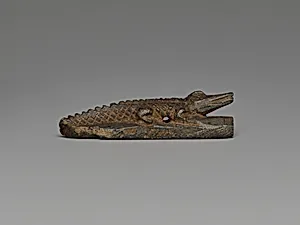
Medium
Steatite
Dimensions
1.3 × 1 × 5 cm (9/16 × 7/16 × 2 in.)
Classification
amulet
Department
Arts of Africa
Museum
Art Institute of Chicago
Accession Number
140855
Rights
Public Domain
About this artwork
Carefully incised by an ancient Egyptian artisan, the jagged scales covering the body of this crocodile add texture and lifelike detail. Ancient Egyptians had several terms for small objects like this, which we call “amulets.” Worn by the living and the dead, these charms were meant to bring protection, health, and good luck, ensuring the bearer’s well-being in both life and the afterlife. The crocodiles that previously lived on the banks of the Nile River in Egypt posed a serious threat to nea...
Art Historical Context
This petite Amulet of a Crocodile, carved steatite during Egypt's New Kingdom to Third Intermediate Period (ca. 1500–664 BCE), exemplifies the exquisite craftsmanship of ancient Egyptian artisans. Measuring just 1.3 × 1 × 5 cm, its compact form suggests it was worn as personal jewelry or placed in tombs, a common practice for protective talismans. Steatite, a soft soapstone, allowed for intricate detailing, often glazed to enhance durability and luster, making it ideal for such small-scale works. In ancient Egyptian culture, amulets like this held profound apotropaic power, believed to safeguard wearers from harm in life and the afterlife. The crocodile form likely evoked the Nile's formidable wildlife, symbolizing strength, fertility, and protection—qualities revered in a civilization dependent on the river's cycles. Produced in vast numbers during these dynamic eras of pharaonic rule and transition, such artifacts reveal the Egyptians' blend of artistry and spirituality. Today, housed in the Art Institute of Chicago's Arts of Africa department, this amulet invites us to ponder the enduring human desire for safeguarding charms, bridging millennia with its timeless appeal.
About the Artist
Ancient Egyptian
Ancient Egyptian artists, a collective of highly skilled artisans spanning over three millennia from the Predynastic period (c. 6000–3150 BC) to the Roman era (30 BC–4th century AD), produced some of humanity's most enduring masterpieces. These anonymous craftsmen, often organized in state-sponsored workshops, lived in dedicated communities like Deir el-Medina near Luxor during the New Kingdom (c....