
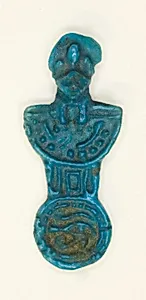
Amulet of a Menat Counterpoise with Lion-headed Goddess
Third Intermediate Period, Dynasty 25–Late Period, Dynasty 26, about 747–525 BCE
Medium
Faience
Dimensions
3.7 × 1.2 × 0.5 cm (1 1/2 × 1/2 × 1/4 in.)
Classification
amulet
Department
Arts of Africa
Museum
Art Institute of Chicago
Accession Number
141169
Rights
Public Domain
About this artwork
Ancient Egyptians, both living and dead, wore amulets of gods and goddesses— depictions of deities in their human, animal, or mixed forms—to bring protection and health. This example shows a small, lion-headed goddess atop a menat counterpoise, a beaded necklace with a counterweight attached to the back to hold it in place. Ancient Egyptians used the menat in religious ceremonies, where it could simply be worn or could serve as a percussion instrument, since shaking it created noise that calmed ...
About the Artist
Ancient Egyptian
Ancient Egyptian artists, a collective of highly skilled artisans spanning over three millennia from the Predynastic period (c. 6000–3150 BC) to the Roman era (30 BC–4th century AD), produced some of humanity's most enduring masterpieces. These anonymous craftsmen, often organized in state-sponsored workshops, lived in dedicated communities like Deir el-Medina near Luxor during the New Kingdom (c....