
Amulet of an Ankh
Third Intermediate Period–Late Period (1070–332 BCE)
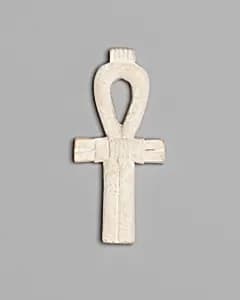
Medium
Low-fired earthenware or stucco
Dimensions
4 × 2 × 0.5 cm (1 5/8 × 3/4 × 3/16 in.)
Classification
amulet
Department
Arts of Africa
Museum
Art Institute of Chicago
Accession Number
136258
Rights
Public Domain
About this artwork
Small-scale Egyptian figurines, known as amulets, were thought to promote health and good luck. Amulets were such an important part of Egyptian religious beliefs that they were worn by both the living and the dead. They could be mounted on rings or strung as bracelets or necklaces and were placed among the mummy wrappings to secure the deceased’s rebirth and well-being in the afterlife. Many varieties of amulets survive, including figures of deities, parts of the human (or divine) body, animals,...
About the Artist
Ancient Egyptian
Ancient Egyptian artists, a collective of highly skilled artisans spanning over three millennia from the Predynastic period (c. 6000–3150 BC) to the Roman era (30 BC–4th century AD), produced some of humanity's most enduring masterpieces. These anonymous craftsmen, often organized in state-sponsored workshops, lived in dedicated communities like Deir el-Medina near Luxor during the New Kingdom (c....