
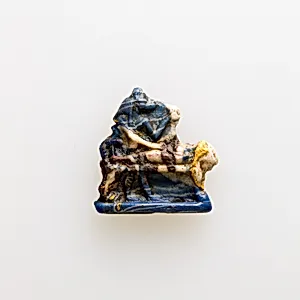
Amulet showing Anubis standing over mummy on bier
Unknown Artist
332–30 B.C.
Medium
Glass
Dimensions
H. 2.7 × W. 2.6 cm (1 1/16 × 1 in.)
Classification
Amulet, Anubis, bier
Period
Ptolemaic Period
Department
Egyptian Art
Museum
Metropolitan Museum of Art, New York, NY
Credit
Gift of J. Pierpont Morgan, 1917
Accession Number
17.194.2518
Rights
Public Domain
Tags
Art Historical Context
This delicate glass amulet from Egypt's Ptolemaic Period332–30 B.C.) captures a poignant funerary scene: the jackal-headed god Anubis stands protectively over a mummy laid out on a bier. Measuring just 2.7 x 2.6 cm, this tiny artifact—now in the Metropolitan Museum of Art's Egyptian Art collection—was likely placed on a mummy or worn as a protective talisman to safeguard the deceased in the afterlife. Anub, the ancient Egyptian god of embalming the underworld, played a central role in mummification rituals, guiding souls through the perilous Duat. Amulets like this invoked his power to ensure safe passage and resurrection, blending deep-rooted Egyptian beliefs with Hellenistic influences under Ptolemaic rule. Such objects were essential in tombs, embodying hopes for eternity amid daily life's uncertainties. Crafted from glass—a relatively rare and translucent medium for amulets—this piece may have mimicked costlier faience or stone, highlighting innovative techniques in Ptolemaic workshops. Its vibrant preservation offers a window into personal piety and the era's fusion of cultures, reminding us of ancient Egyptians' profound reverence for the journey beyond death.