
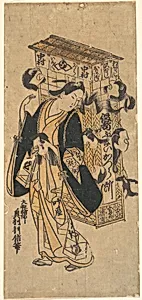
An Actor With a Rack of Wigs
Medium
Woodblock print; ink and color on paper
Dimensions
12 1/4 x 5 3/4 in. (31.1 x 14.6 cm)
Classification
Prints
Culture & Period
Japan · Edo period (1615–1868)
Department
Asian Art
Museum
Metropolitan Museum of Art, New York, NY
Credit
Bequest of Julia H. Manges, in memory of her husband, Dr. Morris Manges, 1960
Accession Number
JP3409
Rights
Public Domain
Tags
Art Historical Context
In the vibrant world of Edo-period Japan (1615–1868), woodblock prints like *An Actor With a Rack of Wigs* by Okumura Toshobu captured the glamour of kabuki theater. Toshinobu, an innovative ukiyo-e active in the early 0s, specialized in yakusha-e—portraits of actors that celebrated their star power and dramatic personas. This intimate hosoban-format print (narrow and vertical, measuring just 12¼ x 5¾ inches) likely depicts a kabuki performer surrounded by a rack of wigs, essential props that transformed actors into gods, ghosts, or warriors on stage. The medium of ink and color on paper showcases the meticulous woodblock technique: carvers and printers layered vibrant hues using multiple blocks, achieving lifelike details in fabrics, expressions, and hairstyles. These affordable prints were pasted in homes or sold as souvenirs, democratizing theater culture amid Edo's booming urban entertainment scene. Wigs, or *katsura*, were cultural icons, signaling character types and social satire in kabuki's all-male casts. Today, at the Metropolitan Museum of Art (Bequest of Julia H. Manges, 1960), this work offers a window into Japan's "floating world" of fleeting pleasures, blending artistry with everyday fascination for performers who blurred art and reality.
About the Artist
Okumura Toshinobu · 1690–1770
active ca. 1717–1750